¶ Fasting and Time-Restricted Feeding
Harnessing evolutionary biology for metabolic flexibility and cellular rejuvenation.
¶ At a Glance
What is it?
Fasting is the voluntary abstinence from food (and sometimes drink) for a specific period. Unlike starvation, which is involuntary and harmful, fasting is a controlled stressor (hormesis) that triggers ancient survival mechanisms. The most common modern iteration is Time-Restricted Feeding (TRF), where eating is confined to a specific window (e.g., 8 hours) each day.

Why do it?
Beyond weight loss, fasting is a potent trigger for autophagy (cellular cleanup), improved insulin sensitivity, and metabolic flexibility (switching fuel from glucose to fat). It is one of the few interventions consistently linked to lifespan extension in animal models.
Key Takeaway
Fasting is not just about "not eating"—it is a metabolic reset. While 16:8 is a great entry point for daily maintenance, deeper benefits like significant autophagy and immune system rebooting typically require longer durations (24h+). It is not suitable for everyone, particularly those with a history of eating disorders, pregnant women, or Type 1 diabetics.
¶ The "Why": Benefits & Health Outcomes
¶ 1. Metabolic Flexibility & Insulin Sensitivity
The modern "Standard American Diet" keeps insulin levels perpetually elevated, locking the body in fat-storage mode. Fasting lowers insulin, allowing the body to access stored body fat for energy. This "Metabolic Switch" from glucose to ketones is the cornerstone of fasting's benefits.
- Evidence: Human trials show TRF significantly lowers fasting insulin and improves insulin resistance (HOMA-IR), a key driver of aging and chronic disease[1][2].
¶ 2. Autophagy: Cellular Recycling
Autophagy (literally "self-eating") is the body's method of clearing out damaged cells, misfolded proteins, and organelles. It is a critical anti-aging process.
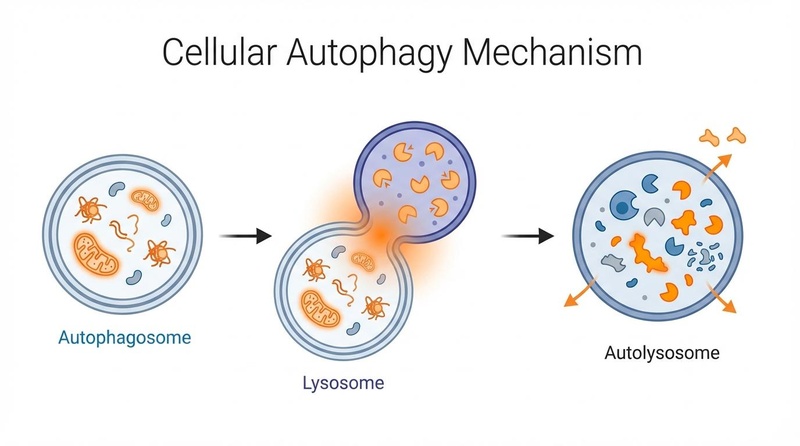
- The Nuance: Autophagy is always happening at a low level, but it upregulates significantly only after glycogen stores are depleted and insulin drops.
- Timeline: In humans, significant upregulation likely begins around 16-18 hours, doubling by 24 hours, and peaking around 48-72 hours[3][4]. Short fasts (12h) may not trigger deep autophagy.
¶ 3. Inflammation & Oxidative Stress
Fasting reduces markers of systemic inflammation (like CRP) and oxidative stress. By temporarily removing the "work" of digestion and the influx of inflammatory food compounds, the gut lining can heal, and the immune system can reset.
- Impact: Reductions in oxidative stress contribute to better cardiovascular health and potentially reduced cancer risk[5].
¶ 4. Weight Loss & Body Composition
While calories still matter, fasting provides a hormonal advantage. By compressing the eating window, most people naturally reduce caloric intake by ~20-30% without counting calories. More importantly, the low-insulin state preserves metabolic rate better than chronic caloric restriction (the "eat less, move more" approach which often crashes metabolism)[6].
¶ Reality Check: Context & Limitations
¶ The "Non-Responder"
Not everyone feels great fasting. Some individuals experience high cortisol (stress hormone) spikes, leading to insomnia, irritability, or stalled weight loss. This is more common in those with high existing life stress or adrenal fatigue.
¶ Women vs. Men
Women may be more sensitive to energy deprivation due to reproductive biology (kisspeptin neurons).
- Female Context: Some women report cycle irregularities or worsened PMS with aggressive fasting (like OMAD). A "gentler" approach (e.g., 14:10 or 16:8) is often recommended for women of reproductive age, whereas post-menopausal women may tolerate longer fasts similarly to men.
¶ "Dirty" Fasting vs. Clean Fasting
Does coffee break a fast?
- Strict Autophagy: Water only. Even coffee or tea might stimulate liver enzymes slightly, though consensus suggests black coffee/tea is fine for metabolic goals.
- Metabolic Fasting: Black coffee, tea, and water are generally accepted.
- The Trap: Artificial sweeteners, cream, or BCAAs can spike insulin or mTOR, effectively stopping the benefits of the fast while leaving you hungry.
¶ Protocols: Which One is Right for You?
¶ Time-Restricted Feeding (TRF) / Intermittent Fasting (IF)
These are daily cycles of eating and fasting.
| Protocol | Structure | Best For | Difficulty |
|---|---|---|---|
| 12:12 | Fast 12h, Eat 12h | Beginners, gut rest | Very Low |
| 16:8 | Fast 16h, Eat 8h | Fat loss, maintenance, lifestyle | Low/Medium |
| 20:4 | Fast 20h, Eat 4h | "Warrior Diet", deeper ketosis | Medium |
| OMAD | One Meal A Day (23:1) | Maximum convenience, rapid weight loss | High |
- 16:8 (Leangains): The most popular. Example: Skip breakfast, eat 12 PM – 8 PM.
- OMAD: Intense. Can be hard to get sufficient protein/nutrients in one sitting.
¶ Periodic Fasting
Fasting for longer periods, but less frequently.
- 5:2 Diet: Eat normally 5 days; eat very low calories (~500 kcal) on 2 non-consecutive days.
- Alternate Day Fasting (ADF): Fasting every other day (or eating <500 kcal). Very effective for insulin resistance but socially difficult.
¶ Prolonged Fasting (>24 Hours)
- 24-72 Hours: Water only. Targets deep autophagy and immune system regeneration.
- Safety: Fasts >3 days should be medically supervised due to electrolyte risks.
- Refeeding: Crucial to break a long fast gently (broth, cooked veggies) to avoid GI distress or Refeeding Syndrome.
¶ Evidence & Science
¶ Human vs. Mouse Data
Much of the "longevity" hype comes from rodent studies where alternate-day fasting increased lifespan by 30-80%.
- Human Reality: We don't have multi-decade human RCTs for lifespan. However, short-term human trials confirm improvements in biomarkers of aging: reduced IGF-1, lower blood pressure, improved lipid profiles, and reduced visceral fat[1:1][7].
- Autophagy Proof: Human muscle biopsies confirm that LC3-II (an autophagy marker) increases significantly after 24h of fasting[3:1].
¶ Cognitive Function
Fasting increases BDNF (Brain-Derived Neurotrophic Factor), often called "fertilizer for the brain." This may explain the mental clarity and focus reported by fasters after the initial hunger wave passes (usually day 2-3).
¶ Practicality: Safety & Contraindications
¶ Who Should NOT Fast?
- Pregnant or Breastfeeding Women: Nutrient needs are too high.
- Type 1 Diabetics: High risk of hypoglycemia/ketoacidosis without strict medical management.
- History of Eating Disorders: Fasting can trigger binge/restrict cycles.
- Underweight (BMI < 18.5): Risk of muscle wasting and hormonal shutdown.
- Children/Adolescents: Growing bodies need consistent fuel.
¶ Side Effects
- Hunger: Waves of ghrelin typically peak at usual meal times and subside after ~20-30 minutes.
- Electrolytes: Headaches, dizziness, or "keto flu" are often due to sodium/potassium loss. Supplementing electrolytes (sugar-free) is crucial for fasts >16h.
- Coldness: Drop in body temperature is normal (metabolic slowing/blood flow diversion).
¶ Tips for Success
- Hydrate: Drink water with a pinch of salt.
- Start Slow: Don't jump to OMAD; start with 12:12 and push breakfast back by an hour each week.
- Nutrient Density: When you do eat, prioritize protein and fiber. Feasting on junk food post-fast negates the benefits.
¶ References
Sutton, E. F., et al. (2018). Early Time-Restricted Feeding Improves Insulin Sensitivity, Blood Pressure, and Oxidative Stress Even without Weight Loss in Men with Prediabetes. Cell Metabolism. https://doi.org/10.1016/j.cmet.2018.04.010 ↩︎ ↩︎
Albosta, M., & Bakke, J. (2021). Intermittent fasting: is there a role in the treatment of diabetes? A review of the literature and guide for primary care physicians. Clinical Diabetes and Endocrinology. https://clindiabetesendo.biomedcentral.com/articles/10.1186/s40842-020-00116-1 ↩︎
Vendelbo, M. H., et al. (2014). Exercise and fasting activate autophagy in human skeletal muscle. Journal of Physiology. https://physoc.onlinelibrary.wiley.com/doi/full/10.1113/jphysiol.2014.271544 ↩︎ ↩︎
Antunes, F., et al. (2018). Autophagy and intermittent fasting: the connection for cancer therapy? Clinics. https://www.ncbi.nlm.nih.gov/pmc/articles/PMC6257056/ ↩︎
Harvie, M. N., et al. (2011). The effects of intermittent or continuous energy restriction on weight loss and metabolic disease risk markers: a randomized trial in young overweight women. International Journal of Obesity. https://www.nature.com/articles/ijo2010171 ↩︎
Patikorn, C., et al. (2022). Intermittent Fasting and Obesity-Related Health Outcomes: An Umbrella Review of Meta-analyses of Randomized Clinical Trials. JAMA Network Open. https://jamanetwork.com/journals/jamanetworkopen/fullarticle/2787246 ↩︎
Longo, V. D., & Panda, S. (2016). Fasting, Circadian Rhythms, and Time-Restricted Feeding in Healthy Lifespan. Cell Metabolism. https://www.cell.com/cell-metabolism/fulltext/S1550-4131(16)30250-9 ↩︎