¶ FOXO4-DRI: Targeted Senolytic for Cellular Rejuvenation
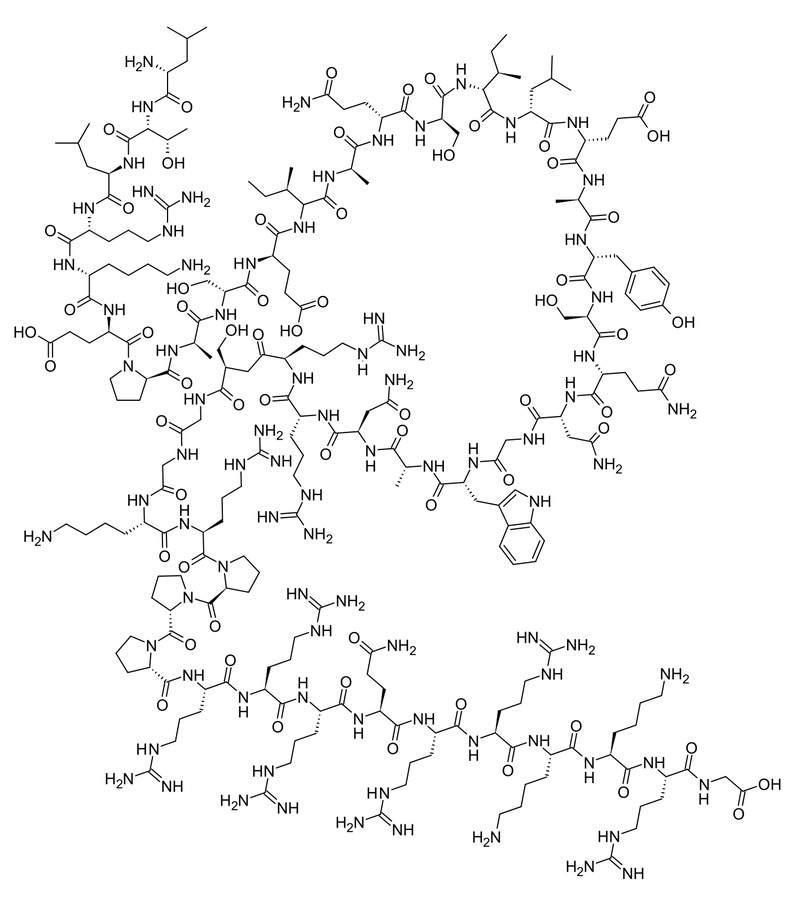
| Sequence | LTLRKEPASEIAQSILEAYSQNGWANRRSGGKRPPPRRRQRRKKRG (D-isoforms) |
| Type | D-Retro-Inverso (DRI) Peptide |
| Molar Mass | ~5358.2 g/mol |
| Category | Senolytic |
| Half-life | Unknown (Human) / Enhanced stability vs L-peptides |
| Admin | Subcutaneous (Experimental) |
| FDA Status | Not Approved / Preclinical |
FOXO4-DRI (Proxofim) is a designer peptide that selectively targets and eliminates senescent cells ("zombie cells") by disrupting the interaction between the proteins FOXO4 and p53. Unlike many senolytics that are repurposed cancer drugs (like Dasatinib) or plant extracts (like Quercetin), FOXO4-DRI was engineered specifically for senolysis based on the unique molecular signature of senescent cells. In landmark mouse studies, it restored fur density, improved kidney function, and reversed signs of frailty, sparking intense interest in the longevity community despite a complete lack of human clinical trials.
¶ At a glance
Aliases
- Proxofim
- FOXO4-D-Retro-Inverso
- Sequence length: 46 amino acids (D-form)
- Category: Targeted Senolytic
Key points
- Mechanism: It forces senescent cells to undergo apoptosis (programmed cell death) by releasing p53 from FOXO4 sequestration, while leaving healthy cells unharmed.
- Mouse Evidence: Demonstrated profound rejuvenation effects in aged mice, including hair regrowth and improved renal function, in a 2017 Cell paper.
- Human Status: There are NO published human clinical trials. All use is experimental and off-label.
- Cost & Availability: Extremely expensive to synthesize due to its length and use of D-amino acids; "bath tub" synthesis carries high risks of impurities.
What people use it for
- Systemic rejuvenation (removing senescent cell burden)
- Hair restoration (based on mouse data)
- Kidney health
- Frailty reduction
¶ Legal & regulatory status
⚠️ CRITICAL INFORMATION: EXPERIMENTAL COMPOUND
Regulatory classification
- FDA Status: Unapproved. FOXO4-DRI is currently a preclinical research compound. It has not been evaluated by the FDA for safety or efficacy in humans.
- Classification: Research Chemical. It is not a scheduled substance but is not approved for human use.
Sports and competition
- WADA Status: Not explicitly named on the Prohibited List as of 2025, but likely falls under "S0. Non-Approved Substances" (substances with no current approval by any governmental regulatory health authority for human therapeutic use).
Source quality considerations
- Complexity: Synthesizing a 46-amino acid peptide with D-enantiomers is technically difficult and expensive.
- Counterfeit Risk: High. Cheap versions found online are likely to be underdosed, impure, or contain completely different substances due to the high cost of legitimate production (often thousands of dollars per course).
¶ What is FOXO4-DRI?
FOXO4-DRI is a synthetic peptide developed to target a specific survival mechanism used by senescent cells.
¶ The "Zombie Cell" Problem
Senescent cells are damaged cells that have stopped dividing but refuse to die. They linger in tissues and secrete a toxic cocktail of inflammatory signals (the SASP—Senescence-Associated Secretory Phenotype) that damages neighboring healthy cells and accelerates aging.
Normally, a protein called p53 (the "guardian of the genome") would detect this damage and trigger the cell to commit suicide (apoptosis). However, in senescent cells, p53 is often trapped and neutralized by another protein, FOXO4.
¶ The Solution: A Molecular Crowbar
FOXO4-DRI mimics the segment of FOXO4 that binds to p53.
- D-Retro-Inverso (DRI): The peptide is built using D-amino acids (mirror images of natural L-amino acids) in reverse order. This makes it resistant to natural enzymes that would normally digest peptides, allowing it to stay in the body longer.
- Action: It acts as a decoy. It enters the cell and binds to p53, displacing the natural FOXO4.
- Result: The liberated p53 is then free to do its job—initiating apoptosis. Crucially, because this FOXO4-p53 locking mechanism is specific to senescent cells, healthy cells are largely unaffected.
¶ What are FOXO4-DRI's main benefits?
Note: The benefits listed below are derived almost exclusively from animal models (mice) and in vitro (cell culture) studies. Human efficacy has not been established.
¶ 1. Reversal of Frailty and Physical Decline
In the landmark 2017 study by Baar et al., naturally aged mice treated with FOXO4-DRI showed improved responsiveness and physical exploration. They were able to run longer distances on running wheels compared to untreated controls, suggesting a reversal of general physical frailty.
¶ 2. Hair Regrowth and Coat Restoration
One of the most visually striking findings in mice was the restoration of fur. Aged mice often lose fur and develop patches of gray/balding skin. Treatment with FOXO4-DRI significantly improved hair density, a result linked to the clearance of senescent cells in the skin stem cell niche.
¶ 3. Kidney Function Recovery
Senescent cells accumulate in the kidneys of aged mice and humans, contributing to fibrosis and loss of filtration capacity. FOXO4-DRI normalized levels of urea and other markers of kidney dysfunction in aged mice, effectively rejuvenating the organ's filtration ability.
¶ 4. Safety to Healthy Tissue
Unlike chemotherapy-based senolytics (which can be toxic to healthy dividing cells), FOXO4-DRI appeared to have a high safety margin in mice. It did not cause significant changes in blood cell counts or liver markers, supporting the theory that its target (the FOXO4-p53 complex) is specific to senescent cells.
¶ Evidence summary (Preclinical)
Since there are no human clinical trials, we present a summary of key preclinical findings.
| Outcome / Goal | Model | Effect | Study | Notes |
|---|---|---|---|---|
| Frailty / Endurance | Aged Mice | ↑ Running distance | Baar et al. (2017) | Mice ran significantly further after treatment. |
| Hair Growth | Aged Mice | ↑ Coat density | Baar et al. (2017) | Visually apparent restoration of fur. |
| Kidney Function | Aged Mice | ↓ Urea / ↑ Filtration | Baar et al. (2017) | Reduced glomerulosclerosis and improved filtration. |
| Liver Fibrosis | Mice | ↓ Fibrosis | Baar et al. (2017) | Cleared senescent hepatic stellate cells. |
| Osteoarthritis | Human Chondrocytes | ↓ Senescence | Zhang et al. (2021) | Ex vivo study on human cartilage cells; reduced inflammatory factors. |
¶ How does FOXO4-DRI work?
¶ Mechanism of Action
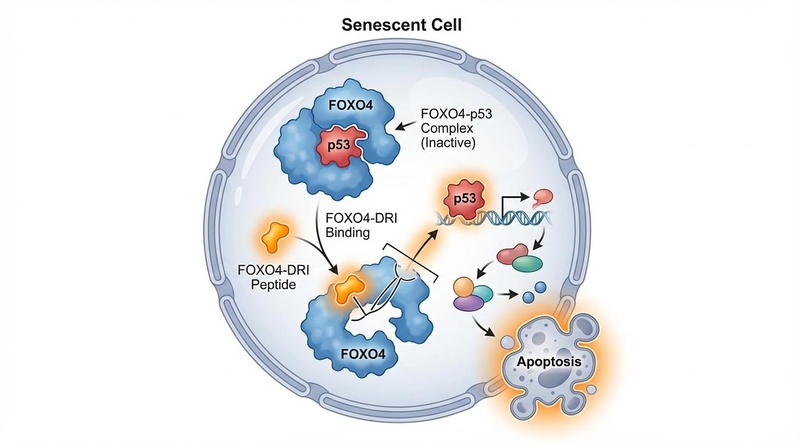
- Target: The interaction between FOXO4 and p53.
- Senescent State: In senescent cells, FOXO4 expression is elevated. It binds to p53 and sequesters it in the nucleus, preventing p53 from activating the mitochondrial apoptosis pathway. This keeps the damaged cell alive.
- Peptide Intervention: FOXO4-DRI enters the cell (it has "cell-penetrating" properties due to its sequence). It competes with the natural FOXO4 protein for binding to p53.
- Liberation: p53 is released from the complex.
- Execution: Free p53 activates Caspase-3 and other apoptotic factors, causing the senescent cell to die. Healthy cells, which do not rely on this FOXO4-p53 lock for survival, are spared.
¶ Pharmacokinetics
- Stability: The D-amino acid structure (Retro-Inverso) makes the peptide highly resistant to proteolytic degradation in the blood, significantly extending its half-life compared to standard L-peptides.
- Distribution: It appears to penetrate tissues well, including the kidney, skin, and liver.
¶ Administration and Protocols
⚠️ Warning: There is no medical consensus on human dosing. The following information reflects anecdotal reports from biohacking communities and extrapolations from animal studies.
¶ Routes of Administration
- Subcutaneous (SubQ) Injection: The most common route used in animal studies and by self-experimenters.
- Intravenous (IV): Used in some animal models but less common for personal use.
¶ Anecdotal Protocols (The "Hit-and-Run" Approach)
Because senolytics are designed to kill existing senescent cells, they are not meant to be taken continuously. The goal is a "cleanup" phase followed by a long break to allow tissues to regenerate.
- Common "Cycle": 10–20 mg per day for 3–5 days, repeated once or twice a year.
- Total Cycle Dose: Often ranges from 30 mg to 100 mg total per course.
- Rationale: Continuous suppression of p53 or FOXO4 is not desirable, as these proteins are essential for tumor suppression and stress resistance in healthy cells. The "pulse" dosing aims to clear the trash and then step back.
¶ Reconstitution
- Solvent: Bacteriostatic water.
- Handling: Due to its length and structure, it may be more difficult to dissolve than shorter peptides. Gentle swirling is essential; do not shake.
¶ Safety and Side Effects
The safety profile of FOXO4-DRI in humans is unknown.
¶ Theoretical Risks
- Off-Target p53 Activation: p53 is the master regulator of cell death. While the peptide is designed to be specific to the FOXO4 complex, unintended manipulation of p53 in healthy cells could theoretically risk killing healthy tissue or, paradoxically, interfering with tumor suppression mechanisms (though the 2017 paper argues it restores tumor suppression).
- Immune Reaction: As a synthetic D-peptide, there is a risk that the immune system could recognize it as foreign and mount an allergic reaction or develop antibodies, potentially neutralizing it or causing autoimmunity.
- Tissue Structural Integrity: Rapidly clearing a large number of senescent cells (which may be structurally supporting tissue, even if dysfunctionally) could theoretically lead to temporary tissue weakness or structural issues until stem cells regenerate the area.
¶ Reported Side Effects (Anecdotal)
- Fatigue / "Flu-like" symptoms (often attributed to the "die-off" of senescent cells and the resulting immune cleanup process, sometimes called the Herxheimer reaction).
- Muscle aches.
- Injection site irritation.
¶ Cost Considerations
FOXO4-DRI is one of the most expensive peptides on the market.
- Synthesis Difficulty: The 46-amino acid length and D-form requirement make synthesis complex and low-yield.
- Price: A single 10 mg vial can cost hundreds of dollars. A full "course" (e.g., 30–60 mg) can exceed $1,000–$2,000.
- Buyer Beware: Prices significantly lower than this range suggest the product is likely fake or underdosed.
¶ Practical Questions (FAQ)
1. Is FOXO4-DRI better than Dasatinib + Quercetin (D+Q)?
FOXO4-DRI is theoretically more targeted. D+Q works by inhibiting broad kinase pathways, which can have off-target effects on healthy cells. FOXO4-DRI targets a specific interaction found primarily in senescent cells. However, D+Q has human clinical trial data, while FOXO4-DRI does not.
2. Will it make my hair grow back?
While this was a clear result in mice, mouse hair biology differs from human hair loss (androgenic alopecia). There is no confirmation that it works for human male pattern baldness.
3. Can I take it orally?
Even though D-peptides are more stable, a 46-amino acid peptide is too large to be absorbed intact through the gut. Injection is currently the only effective route.
4. How often should I take it?
The consensus in the longevity community—based on the nature of senolytics—is that it should be used infrequently (e.g., once or twice a year). Continuous use is likely dangerous and counterproductive.
¶ References
- Baar, M. P., et al. (2017). Targeted Apoptosis of Senescent Cells Restores Tissue Homeostasis in Response to Chemotoxicity and Aging. Cell, 169(1), 132–147.e16. https://doi.org/10.1016/j.cell.2017.02.031
- Zhang, C., et al. (2021). Senolytic Peptide FOXO4-DRI Selectively Removes Senescent Cells From in vitro Expanded Human Chondrocytes. Frontiers in Bioengineering and Biotechnology, 9, 677576. https://doi.org/10.3389/fbioe.2021.677576
- Han, Y., et al. (2022). FOXO4-DRI alleviates age-related testosterone secretion insufficiency by targeting senescent Leydig cells in aged mice. Aging (Albany NY), 14(2), 102682. https://doi.org/10.18632/aging.102682
- Mendelsohn, A. R., & Larrick, J. W. (2017). FOXO4-DRI: A Senolytic Peptide to Rejuvenate Aging Tissues. Rejuvenation Research, 20(3), 247–251. https://doi.org/10.1089/rej.2017.1965