¶ Hexarelin
Hexarelin (examorelin) is a synthetic hexapeptide and one of the most potent Growth Hormone Secretagogues (GHS) available. It is an analogue of GHRP-6 but significantly more stable and potent.
Unique among its class, Hexarelin possesses a dual mechanism of action: it stimulates massive Growth Hormone (GH) release via the ghrelin receptor (GHS-R1a) and exerts direct cardioprotective effects via the CD36 receptor. This makes it a compound of high interest for cardiac recovery and ischemia protection, beyond typical body composition goals. However, its potency comes with rapid desensitization (tachyphylaxis) and elevations in cortisol and prolactin, necessitating strict cycling protocols.
Unlike Ipamorelin or GHRP-6, Hexarelin induces rapid receptor downregulation. Efficacy for GH release drops significantly after 4–16 weeks of continuous use. It must be cycled to maintain potency.
¶ At a Glance
| Feature | Specification |
|---|---|
| Primary Class | Growth Hormone Secretagogue (GHRP) |
| Secondary Target | CD36 Scavenger Receptor (Cardioprotection) |
| Potency | Very High (+++++) |
| Systemic Half-life | ~55 minutes |
| Key Benefit | Maximum GH release pulse + Heart tissue repair |
| Side Effects | Increased Cortisol/Prolactin, flushing, fatigue |
¶ Protocol & Administration
¶ Standard Research Protocol
Goal: Pulse GH release and cardioprotection while mitigating desensitization.
- Dosage: 100 mcg to 200 mcg per administration.
- Clinical studies often use 1–2 µg/kg body weight.
- Doses above 2 µg/kg do not significantly increase GH output (saturation point).
- Frequency: 1 to 2 times daily (b.i.d.).
- Ideally administered pre-workout or before bed.
- Route: Subcutaneous (Sub-Q) injection.
- Cycling (Mandatory):
- On-Cycle: 4 to 6 weeks.
- Off-Cycle: 2 to 4 weeks (minimum washout to reset receptors).
¶ Stacking
Hexarelin is frequently stacked to amplify the GH pulse or mitigate side effects:
- With GHRH (CJC-1295 No DAC / Mod GRF 1-29): Synergistic effect. The GHRH amplifies the pulse initiated by Hexarelin, creating a massive neuroendocrine release larger than the sum of parts.
- NOT with other GHRPs: Do not stack with GHRP-6, GHRP-2, or Ipamorelin, as they compete for the same receptors.
¶ Benefits & Clinical Context
¶ 1. Potent Growth Hormone Release
Hexarelin is widely considered the strongest GH-releasing peptide in the GHRP family, capable of eliciting higher peak GH levels than GHRP-6 or GHRP-2 [1][2].
- Muscle & Recovery: The massive GH pulse drives IGF-1 production, supporting muscle protein synthesis, nitrogen retention, and soft tissue repair.
- Fat Loss: GH is a potent lipolytic agent; Hexarelin accelerates the oxidation of fatty acids.
¶ 2. Cardioprotection & Repair (The CD36 Advantage)
This is Hexarelin's defining therapeutic feature. It binds to the CD36 receptor on heart tissue, a property shared with Ghrelin but not most other synthetic GHRPs.
- Ischemia-Reperfusion Injury: Research shows Hexarelin protects heart muscle from damage caused by blood flow restoration after a heart attack (ischemia-reperfusion). It reduces myocardial scarring and oxidative stress [3][4].
- Improved Heart Function: In models of heart failure, Hexarelin has improved Left Ventricular Ejection Fraction (LVEF) and cardiac output independent of Growth Hormone levels. Even in the absence of a pituitary gland, Hexarelin protects the heart [5].
¶ 3. Neuroprotection
Emerging evidence suggests Hexarelin may protect neurons from toxicity and oxidative stress, potentially offering therapeutic avenues for neurodegenerative conditions, though human data is limited compared to its cardiac profile [6].
¶ Mechanism of Action
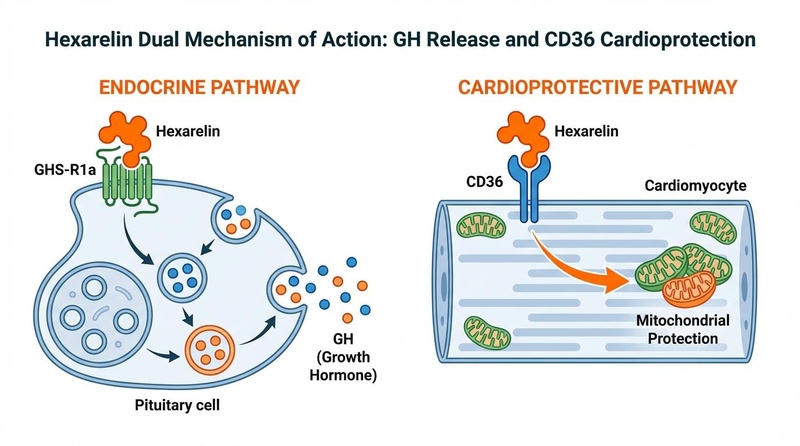
Hexarelin operates through two distinct pathways:
¶ 1. The GHS-R1a Pathway (Endocrine)
Like Ghrelin, Hexarelin binds to the Growth Hormone Secretagogue Receptor 1a (GHS-R1a) in the pituitary and hypothalamus.
- Signaling: This activates the phospholipase C (PLC) pathway, triggering intracellular calcium release and massive depolarization of somatotrophs.
- Result: An immediate, high-amplitude pulse of Growth Hormone.
¶ 2. The CD36 Pathway (Cardiometabolic)
Hexarelin is a high-affinity ligand for CD36, a scavenger receptor class B expressed on cardiomyocytes, endothelial cells, and macrophages.
- Mitochondrial Biogenesis: Activation of CD36 signals the PPAR-gamma pathway, promoting mitochondrial activity and lipid metabolism [7].
- Anti-Atherosclerotic: This pathway facilitates cholesterol efflux from macrophages, potentially reducing foam cell formation and plaque buildup [8].
¶ Evidence & Research
¶ Cardiac Function in Humans
A randomized study in patients with coronary artery disease undergoing bypass surgery found that acute Hexarelin administration significantly increased cardiac index and stroke volume without inducing systemic hypertension or tachycardia. This suggests it acts as a safe inotropic agent for compromised hearts [9].
¶ The Desensitization Issue
A pivotal study on chronic Hexarelin use monitored GH release over 16 weeks.
- Finding: While the GH response was explosive initially, it significantly attenuated (dropped) by weeks 4 and 16.
- Recovery: A 4-week washout period completely restored pituitary sensitivity, validating the necessity of cycling protocols [10].
¶ Safety & Side Effects
Hexarelin is a "dirty" agonist compared to selective peptides like Ipamorelin. It stimulates multiple endocrine axes.
¶ 1. Cortisol & Prolactin Elevation
- Cortisol (Stress Hormone): Hexarelin stimulates ACTH release, leading to elevated serum cortisol. While usually within physiological stress limits, this can be problematic for individuals with anxiety or sleep disturbances [11].
- Prolactin: Dose-dependent increases in prolactin can occur. High prolactin may cause libido issues or gynecomastia in sensitive individuals, though this is rare at standard doses and short durations.
¶ 2. Receptor Desensitization
As noted, the body rapidly adapts to Hexarelin. Continued use beyond 4-8 weeks often results in diminishing returns. This is distinct from GHRP-6 or Ipamorelin, which can be used for months with stable efficacy.
¶ 3. Common Reactions
- Flushing/Warmth: A rush of heat post-injection is common.
- Injection Site Pain: Mild irritation may occur.
- Fatigue: The post-pulse "crash" or lethargy is reported by some users.
¶ Comparisons
| Peptide | GH Potency | Cortisol/Prolactin Risk | Desensitization | Primary Use Case |
|---|---|---|---|---|
| Hexarelin | Highest | Moderate | Rapid | Max growth, Heart health |
| Ipamorelin | Moderate | None | Slow/None | Anti-aging, steady use |
| GHRP-6 | High | Low/Moderate | Slow | Appetite stimulation, bulking |
| GHRP-2 | Very High | Moderate | Moderate | High yield GH release |
¶ References
Arvat, E., et al. (1997). GH-releasing activity of GHRP-2 and Hexarelin in humans. Journal of Clinical Endocrinology & Metabolism. ↩︎
Imbimbo, B. P., et al. (1994). Growth hormone-releasing activity of hexarelin in humans: a dose-response study. Journal of Clinical Endocrinology & Metabolism. ↩︎
Huang, J., et al. (2017). Hexarelin protects cardiomyocytes from ischemia/reperfusion injury via the modulation of the PI3K/Akt signaling pathway. International Heart Journal. ↩︎
Ma, Y., et al. (2012). Growth hormone secretagogues protect mouse cardiomyocytes from in vitro ischemia/reperfusion injury through regulation of intracellular calcium. PLoS One. ↩︎
Tivesten, A., et al. (2000). The growth hormone secretagogue hexarelin improves cardiac function in rats after experimental myocardial infarction. Endocrinology. ↩︎
Brywe, K. G., et al. (2005). Growth hormone-releasing peptide hexarelin reduces neonatal brain injury. Endocrinology. ↩︎
Rodrigue-Way, A., et al. (2007). A growth hormone-releasing peptide that binds scavenger receptor CD36 induces peroxisome proliferator-activated receptor gamma activation. Endocrinology. ↩︎
Febbraio, M., et al. (2001). Targeted disruption of the Class B scavenger receptor CD36 protects against atherosclerotic lesion development in mice. Journal of Clinical Investigation. ↩︎
Broglio, F., et al. (2002). Effects of acute hexarelin administration on cardiac performance in patients with coronary artery disease during by-pass surgery. European Journal of Pharmacology. ↩︎
Rahim, A., et al. (1998). Does desensitization to hexarelin occur? Growth Hormone & IGF Research. ↩︎
Massoud, A. F., et al. (1996). Hexarelin-induced growth hormone, cortisol, and prolactin release: a dose-response study. Journal of Clinical Endocrinology & Metabolism. ↩︎