¶ Epitalon (Epithalon)
Epitalon (also known as Epithalon, Epithalone, or AGAG) is a synthetic tetrapeptide with the amino acid sequence Ala-Glu-Asp-Gly. It was designed as a synthetic analogue of Epithalamin, a polypeptide extract derived from the bovine pineal gland. Discovered by Professor Vladimir Khavinson at the St. Petersburg Institute of Bioregulation and Gerontology, Epitalon is one of the most extensively studied "peptide bioregulators" for its potential geroprotective (anti-aging) properties.
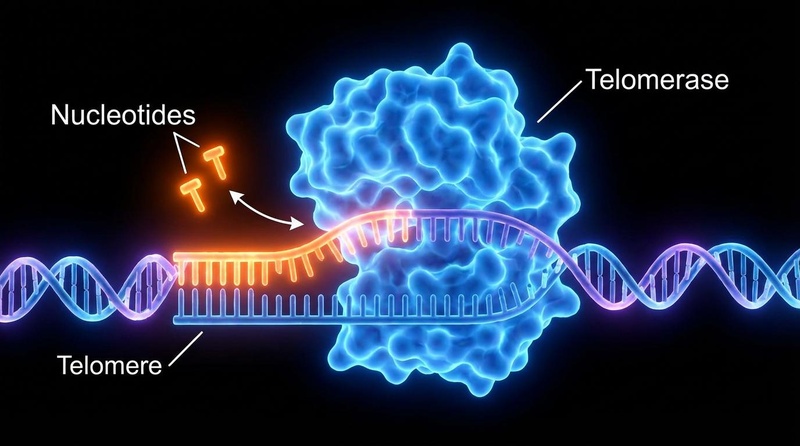
The peptide is primarily known for its ability to activate telomerase (the enzyme responsible for maintaining telomere length) and regulate the neuroendocrine system, specifically melatonin production and circadian rhythms.[1][2]
¶ Mechanism of Action
Epitalon exhibits a pleiotropic mechanism of action, influencing gene expression and enzymatic activity across various tissues. Its primary biological effects are mediated through epigenetic modifications and direct receptor interactions.
¶ Telomerase Activation and Chromatin Remodeling
Epitalon has been shown to induce the expression of the catalytic subunit of telomerase (TERT) in somatic cells. By binding to specific DNA sequences (such as the ATTTC motif) in promoter regions, it upregulates telomerase activity, leading to the elongation of telomeres—the protective caps at the ends of chromosomes that shorten with age.[3]
Research indicates that Epitalon interacts with Histone H1, a protein involved in chromatin structure. By displacing Histone H1, Epitalon may induce chromatin "relaxation" (decondensation), making specific genes more accessible for transcription. This epigenetic mechanism is thought to underlie its ability to reactivate silenced genes associated with youthful cellular function.[4]
¶ Circadian Rhythm and Melatonin Regulation
As a pineal gland peptide mimetic, Epitalon restores the rhythmic production of melatonin, a hormone critical for sleep-wake cycles and immune regulation. Aging is often accompanied by calcification of the pineal gland and a decline in melatonin secretion; Epitalon administration has been observed to normalize these levels in senescent animals and elderly humans, thereby improving sleep quality and antioxidant capacity.[5]
¶ Antioxidant and Gene Expression Effects
The peptide modulates the expression of antioxidant enzymes, including superoxide dismutase (SOD) and glutathione peroxidase. By enhancing the body's endogenous antioxidant defenses, Epitalon reduces oxidative stress, a key driver of the aging process.[6]
¶ Longevity and Healthspan Research
Epitalon has been the subject of numerous studies over several decades, primarily conducted by Russian researchers. While evidence is robust in animal models, human data is largely derived from specific clinical trials in Russia.
¶ Animal Studies: Lifespan and Tumor Suppression
In rodent studies, Epitalon has demonstrated significant life-extending effects. Experiments on mice and rats have shown that long-term administration can increase mean lifespan by 10% to 25% compared to controls.[7]
Notably, Epitalon treatment has been associated with a spontaneous reduction in tumor incidence. In female SHR mice (a strain prone to hypertension and tumors), the peptide significantly inhibited the development of mammary tumors and leukemias. This anti-tumorigenic effect contradicts the theoretical concern that telomerase activation might promote cancer, suggesting that Epitalon's regulation of cell cycle and immune surveillance provides a net protective effect.[8]
¶ Human Clinical Data
Human clinical trials, primarily conducted in Russia, have reported benefits in elderly populations. In a 12-year longitudinal study involving elderly patients with cardiovascular pathology, those treated with Epithalamin (the natural extract Epitalon is based on) showed a lower mortality rate (reduced by approximately 50% over the observation period) compared to the control group.[9]
Additional studies have reported:
- Telomere Elongation: A study involving patients aged 60-65 and 75-80 showed that peptide bioregulator therapy increased telomere length in peripheral blood mononuclear cells.[3:1]
- Functional Improvements: Improvements in sleep quality, physical endurance, and immune parameters have been documented in elderly subjects.[1:1]
¶ Safety and Side Effects
Epitalon is considered to have a favorable safety profile based on available research.
- Toxicity: No toxic effects were observed in animal studies even at dosages significantly higher than therapeutic levels.
- Adverse Events: In human trials involving the natural extract Epithalamin, no severe adverse side effects were reported.
- Carcinogenicity: Contrary to concerns that telomerase activators might fuel cancer growth, animal studies have consistently shown that Epitalon decreases the incidence of spontaneous tumors and inhibits metastasis in certain models.[8:1]
However, as with many research peptides, long-term safety data in diverse global populations outside of the original Russian cohorts is limited.
¶ Current Research Status
While Epitalon is a registered pharmaceutical in Russia (often as the extract Epithalamin), it remains an investigational compound in most Western countries. It is widely available as a "research chemical" but has not been approved by the FDA or EMA for clinical use.
Current research is focused on:
- Elucidating the precise epigenetic mechanisms of peptide-DNA interactions.
- Investigating its potential in neurodegenerative diseases due to its neuroprotective properties.
- Validating its effects on retinal health and visual function restoration.[10]
¶ References
Khavinson VK. Peptides and Ageing. Neuroendocrinology Letters. 2002;23 Suppl 3:11-144. https://pubmed.ncbi.nlm.nih.gov/12374906/ ↩︎ ↩︎
Anisimov VN, Khavinson VK, Provinciali M, et al. Inhibitory effect of the peptide epitalon on the development of spontaneous mammary tumors in HER-2/neu transgenic mice. International Journal of Cancer. 2002;101(1):7-10. https://onlinelibrary.wiley.com/doi/10.1002/ijc.10570 ↩︎
Khavinson VK, Bondarev IE, Butyugov AA. Epithalon peptide induces telomerase activity and telomere elongation in human somatic cells. Bulletin of Experimental Biology and Medicine. 2003;135(6):590-592. https://pubmed.ncbi.nlm.nih.gov/12937682/ ↩︎ ↩︎
Khavinson VK, Linetsky II, Tarnovskaya SI, et al. Peptides and Aging. The Role of Peptide Bioregulators in the Health and Life Expectancy. In: Healthy Aging and Longevity. Springer; 2020. ↩︎
Korkushko OV, Khavinson VK, Shatilo VB, Antonyk-Sheglova IA. Peptide geroprotector from the pineal gland inhibits aging of the immune system in the elderly people. Bulletin of Experimental Biology and Medicine. 2006;142(6):734-738. ↩︎
Kozina LS, Arutjunyan AV, Khavinson VK. Antioxidant properties of geroprotective peptides of the pineal gland. Archives of Gerontology and Geriatrics. 2007;44 Suppl 1:213-216. https://pubmed.ncbi.nlm.nih.gov/17317530/ ↩︎
Anisimov VN, Khavinson VK, Mikhalski AI, Yashin AI. Effect of synthetic peptide epitalon on biomarkers of aging, survival and spontaneous tumor incidence in female Swiss-derived SHR mice. Biogerontology. 2003;4(4):193-202. https://pubmed.ncbi.nlm.nih.gov/14501183/ ↩︎
Kossoy G, Zandbank J, Tendler E, et al. Epitalon and colon carcinogenesis in rats: proliferative activity and apoptosis in colon tumors and mucosa. International Journal of Molecular Medicine. 2003;12(4):473-477. ↩︎ ↩︎
Khavinson VK, Morozov VG. Peptides of pineal gland and thymus prolong human life. Neuroendocrinology Letters. 2003;24(3-4):233-240. https://pubmed.ncbi.nlm.nih.gov/14523363/ ↩︎
Khavinson V, Razumovsky M, Trofimova S, Grigorian R, Razumovskaya A. Pineal-regulating tetrapeptide epitalon improves eye retina condition in retinitis pigmentosa. Neuroendocrinology Letters. 2002;23(4):365-368. https://pubmed.ncbi.nlm.nih.gov/12374923/ ↩︎