Demonstrated safety and efficacy for GH release in humans. Longevity benefits are mechanistic and observational; no long-term randomized trials for life extension.
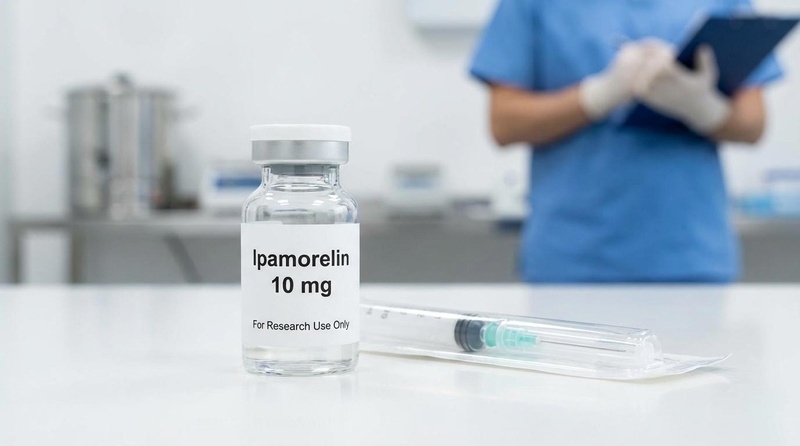
¶ Ipamorelin
Ipamorelin is a synthetic pentapeptide and a selective agonist of the ghrelin/growth hormone secretagogue receptor (GHS-R1a). It belongs to the class of Growth Hormone Releasing Peptides (GHRPs) but is distinct for its high selectivity—it stimulates the release of growth hormone (GH) without significantly affecting cortisol, prolactin, or aldosterone levels[1].
Originally developed by Novo Nordisk for the treatment of postoperative ileus, Ipamorelin has become a popular compound in longevity medicine for its ability to restore pulsatile growth hormone secretion, which naturally declines with age ("somatopause").
¶ Mechanism of Action
Ipamorelin mimics the action of ghrelin, the "hunger hormone," by binding to the GHS-R1a receptor in the pituitary gland. This binding initiates a signaling cascade that results in the release of stored growth hormone into the bloodstream[1:1].
¶ Key Differentiators
Unlike older GHRPs such as GHRP-6 or GHRP-2, Ipamorelin is highly selective:
- Selective GH Release: It triggers a strong pulse of GH similar to GHRP-6.
- No Cortisol/ACTH Spike: It does not stimulate the release of adrenocorticotropic hormone (ACTH) or cortisol, minimizing stress-related side effects[2].
- No Prolactin Spike: It has negligible effects on prolactin, reducing the risk of side effects like gynecomastia or water retention[2:1].
- Less Appetite Stimulation: While it mimics ghrelin, reports and studies suggest it stimulates appetite less intensely than GHRP-6.
¶ Synergy with GHRH
Ipamorelin is frequently combined with Growth Hormone Releasing Hormone (GHRH) analogs like CJC-1295 (Mod GRF 1-29). This combination exploits a synergistic pathway:
- GHRH (CJC-1295): Increases the number of GH-secreting cells activated and potentiates the pulse.
- GHRP (Ipamorelin): Initiates the pulse itself.
Together, they produce a more robust and physiologic release of GH than either alone.
¶ Evidence and Research Status
¶ Human Clinical Trials
Ipamorelin has been tested in human clinical trials, primarily for gastrointestinal indications.
- Pharmacokinetics: A 1999 study in healthy male volunteers confirmed that Ipamorelin induces a dose-dependent release of GH. The study established its safety and pharmacokinetic profile in humans[3].
- Post-Operative Ileus (POI): A large Phase 2 randomized controlled trial (RCT) by Beck et al. (2014) evaluated Ipamorelin (0.03 mg/kg twice daily) in 114 patients undergoing bowel resection.
- Safety: The peptide was well-tolerated with no significant adverse events compared to placebo.
- Efficacy: The study failed to show a significant reduction in time to first meal (recovery of bowel function), leading to the discontinuation of its development for this specific indication[4].
¶ Preclinical & Longevity Research
- Bone Health: Animal studies have shown that Ipamorelin can increase bone mineral density and longitudinal bone growth in rats, suggesting potential applications for osteoporosis or frailty[5].
- Muscle & Body Composition: By increasing plasma GH and subsequently IGF-1 (Insulin-like Growth Factor 1), Ipamorelin theoretically supports muscle protein synthesis and lipolysis (fat breakdown). However, direct human RCTs specifically measuring muscle hypertrophy in healthy adults are lacking.
¶ Efficacy and Benefits
In the context of longevity and age management, reported benefits are largely derived from the known effects of restored GH/IGF-1 levels:
- Improved Body Composition: Increased lean muscle mass and reduced adipose tissue.
- Enhanced Recovery: Faster recovery from exercise and injuries.
- Skin Quality: Potential for improved collagen synthesis and skin elasticity.
- Sleep Quality: Many users report deeper, more restorative sleep (slow-wave sleep is associated with GH release).
¶ Safety Considerations
Ipamorelin is widely considered one of the safest GH secretagogues due to its selectivity.
- Side Effects: In clinical trials, side effects were mild and transient, including injection site reactions (redness/pain) and occasional mild headaches or flushing[4:1].
- Hormonal Impact: The lack of cortisol and prolactin stimulation makes it suitable for longer-term use compared to GHRP-2/6.
- Insulin Resistance: Chronic elevation of GH can lead to insulin resistance. However, because Ipamorelin induces pulsatile rather than continuous GH release (unlike synthetic HGH injections), the risk is generally considered lower, though blood glucose monitoring is still recommended.
- Cancer Risk: Elevating IGF-1 is a double-edged sword; while it promotes tissue repair, high IGF-1 is also associated with tumor growth. Individuals with active cancer or a strong history of cancer should avoid GH secretagogues.
¶ Practical Notes
¶ Administration
- Route: Subcutaneous injection.
- Common Dosage: 100 mcg to 300 mcg per dose, administered 1–3 times daily.
- Timing:
- Empty Stomach: Administered at least 2-3 hours after a meal to prevent insulin/somatostatin from blunting the GH release.
- Bedtime: A pre-bed dose is common to mimic the natural nocturnal GH spike.
- Pre/Post-Workout: Used to support recovery.
¶ Storage
- Lyophilized Powder: Store in a freezer (-20°C) for long-term stability.
- Reconstituted: Once mixed with bacteriostatic water, store in a refrigerator (2-8°C) and use within 3-4 weeks.
¶ References
Raun, K., et al. (1998). Ipamorelin, the first selective growth hormone secretagogue. European Journal of Endocrinology, 139(5), 552-561. ↩︎ ↩︎
Johansen, P. B., et al. (1999). Pharmacokinetic evaluation of ipamorelin and other peptidyl growth hormone secretagogues with emphasis on nasal absorption. Xenobiotica, 29(11), 1083-1092. ↩︎ ↩︎
Gobburu, J. V., et al. (1999). Pharmacokinetic-pharmacodynamic modeling of ipamorelin, a growth hormone releasing peptide, in human volunteers. Pharmaceutical Research, 16(9), 1412-1416. ↩︎
Beck, D. E., et al. (2014). Prospective, randomized, controlled, proof-of-concept study of the Ghrelin mimetic ipamorelin for the management of postoperative ileus in bowel resection patients. International Journal of Colorectal Disease, 29(12), 1527-1534. ↩︎ ↩︎
Svensson, J., et al. (2000). Ipamorelin, a new growth-hormone-releasing peptide, induces longitudinal bone growth in rats. Journal of Endocrinology, 165(3), 569-577. ↩︎