¶ MOTS-c (Mitochondrial Open Reading Frame of the 12S rRNA-c)
MOTS-c (Mitochondrial Open Reading Frame of the 12S rRNA-c) is a peptide of 16 amino acids encoded within the mitochondrial genome. Unlike most peptides which are encoded by nuclear DNA, MOTS-c is derived from a small open reading frame (ORF) within the mitochondrial 12S ribosomal RNA gene. Discovered in 2015, it acts as a retrograde signaling molecule, transmitting information from the mitochondria to the nucleus to regulate cellular metabolism and stress responses[1].
MOTS-c has gained significant attention in longevity research due to its ability to prevent diet-induced obesity, improve insulin sensitivity, and enhance exercise performance in aging models, earning it the designation of an "exercise mimetic"[2].
¶ Mechanism of Action
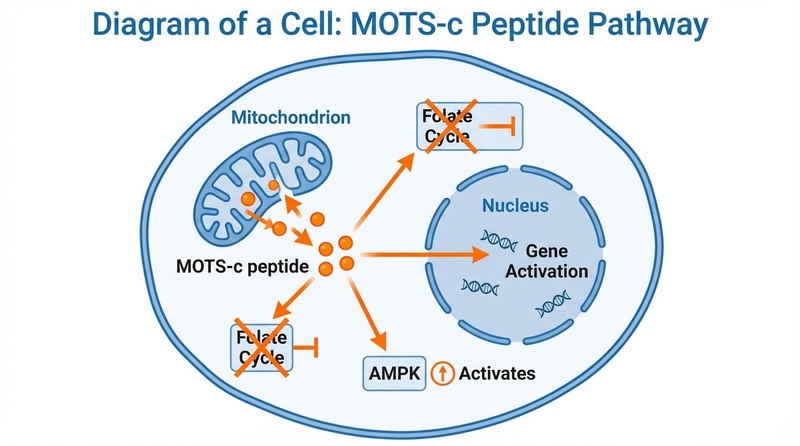
MOTS-c functions as a mitochondrial-derived regulator of metabolism. Its primary mechanism involves translocation from the mitochondria to the nucleus in response to metabolic stress, where it influences gene expression.
¶ Folate-AICAR-AMPK Pathway
The core metabolic effect of MOTS-c is mediated through the folate-AICAR-AMPK pathway.
- Folate Cycle Inhibition: MOTS-c inhibits the folate cycle at the level of 5-methyltetrahydrofolate (5-Me-THF), which restricts the supply of one-carbon units for de novo purine synthesis[1:1].
- AICAR Accumulation: This inhibition leads to an accumulation of AICAR (5-aminoimidazole-4-carboxamide ribonucleotide), an intermediate in purine synthesis.
- AMPK Activation: AICAR is a potent agonist of AMPK (AMP-activated protein kinase), the master regulator of cellular energy homeostasis. By increasing intracellular AICAR levels, MOTS-c activates AMPK, promoting catabolic processes (energy burning) and inhibiting anabolic processes (energy storage)[1:2][3].
¶ Nuclear Translocation and Gene Regulation
Under stress conditions, MOTS-c translocates to the nucleus. It has been shown to interact with transcription factors such as NRF2 (Nuclear Factor Erythroid 2-Related Factor 2), a key regulator of antioxidant and cellular protective genes. This interaction enhances the cellular resistance to metabolic and oxidative stress[3:1].
¶ Metabolic Effects and Insulin Sensitivity
MOTS-c plays a critical role in maintaining metabolic flexibility and glucose homeostasis.
- Insulin Sensitivity: In mouse models, MOTS-c administration significantly improved insulin sensitivity. It enhances glucose uptake in skeletal muscle and suppresses hepatic glucose production, countering the effects of a high-fat diet[1:3].
- Obesity Prevention: Mice fed a high-fat diet and treated with MOTS-c did not develop obesity, despite consuming the same number of calories as untreated controls. This suggests MOTS-c increases energy expenditure and metabolic rate[1:4].
- Fatty Acid Oxidation: By activating AMPK, MOTS-c promotes the oxidation of fatty acids, reducing lipid accumulation in tissues like the liver and muscle.
¶ Evidence Assessment
- Metabolic Regulation: High certainty in murine models; Low certainty in humans due to limited clinical data.
- Weight Loss: Moderate certainty in mice (prevention of gain); Very Low certainty in humans.
¶ Exercise Performance and Physical Capacity

MOTS-c levels in plasma and muscle have been observed to increase in response to physical exercise, leading researchers to classify it as an "exercise-induced mitochondrial peptide"[2:1].
¶ Enhancement of Performance
Research published in Nature Communications (2021) demonstrated that MOTS-c treatment could significantly enhance physical performance in mice of all ages.
- Old Mice: In older mice, short-term treatment (2 weeks) with MOTS-c significantly improved grip strength and running capacity, effectively reversing age-dependent physical decline[2:2].
- Mechanism: The peptide appears to improve skeletal muscle metabolism and mitochondrial function, allowing for sustained energy production during exertion.
¶ Longevity and Aging
Mitochondrial dysfunction is a hallmark of aging. As an inter-organelle signal, MOTS-c levels decline with age, which correlates with the onset of age-related metabolic diseases like type 2 diabetes and sarcopenia.
¶ The "Japanese Centenarian" Polymorphism
Genetic evidence supports a link between MOTS-c and human longevity. A specific polymorphism in the mitochondrial gene encoding MOTS-c (m.1382A>C) acts as a functional variant.
- This variant results in a specific amino acid change (K14Q) in the MOTS-c peptide.
- This polymorphism is found exclusively in populations with exceptional longevity, such as Japanese centenarians, and is associated with a distinct biological activity profile that may confer metabolic protection[4].
¶ Mitohormesis
MOTS-c is considered an agent of mitohormesis—a biological response where mild mitochondrial stress triggers adaptive pathways that improve health and survival. By modulating nuclear gene expression in response to mitochondrial status, it helps the organism adapt to metabolic challenges.
¶ Research Status and Safety
While preclinical data is robust, MOTS-c remains an experimental intervention in humans.
¶ Clinical Trials
- Status: Human clinical trials are in very early stages. There are currently no completed Phase III trials confirming efficacy or safety for general use.
- Availability: MOTS-c is widely available as a research chemical but is not FDA-approved for the treatment of any condition.
¶ Safety Profile
- Potential Risks: Because MOTS-c influences the folate cycle and purine synthesis, there is a theoretical risk of interfering with DNA synthesis or cell proliferation if dosed incorrectly, although this has not been clearly demonstrated as a toxicity in animal studies.
- Injection Site Reactions: As with many peptides, local irritation at the injection site is a common reported side effect in anecdotal user logs.
- Traffic Light Assessment:
- Evidence: Yellow (Strong mechanistic/animal data, limited human data).
- Safety: Yellow (Generally appears safe in animals, but long-term human safety is unproven).
- Action: Proceed with knowledge (Experimental).
¶ References
Lee C, Zeng J, Drew BG, et al. The mitochondrial-derived peptide MOTS-c promotes metabolic homeostasis and reduces obesity and insulin resistance. Cell Metab. 2015;21(3):443-454. doi:10.1016/j.cmet.2015.02.009 ↩︎ ↩︎ ↩︎ ↩︎ ↩︎
Reynolds JC, Lai RW, Woodhead JST, et al. MOTS-c is an exercise-induced mitochondrial-encoded regulator of age-dependent physical decline and muscle homeostasis. Nat Commun. 2021;12(1):470. Published 2021 Jan 20. doi:10.1038/s41467-020-20790-0 ↩︎ ↩︎ ↩︎
Kim KH, Son JM, Benayoun BA, Lee C. The Mitochondrial-Encoded Peptide MOTS-c Translocates to the Nucleus to Regulate Nuclear Gene Expression in Response to Metabolic Stress. Cell Metab. 2018;28(3):516-524.e7. doi:10.1016/j.cmet.2018.06.008 ↩︎ ↩︎
Fuku N, Pareja-Galeano H, Zempo H, et al. The mitochondrial-derived peptide MOTS-c: a player in longevity and healthy aging?. Aging (Albany NY). 2015;7(11):886-890. doi:10.18632/aging.100839 ↩︎