¶ Semax
Semax is a synthetic heptapeptide drug (Met-Glu-His-Phe-Pro-Gly-Pro) derived from a fragment of the adrenocorticotropic hormone (ACTH). Developed in Russia, it is widely used in Eastern European clinical practice for the treatment of ischemic stroke, transient ischemic attacks (TIA), optic nerve disease, and cognitive impairment. Outside of clinical settings, it is popular in the nootropic community for its reported ability to enhance memory, focus, and mood.
Unlike psychostimulants, Semax acts as a melanocortin mimetic and neurotrophic factor inducer, modulating brain-derived neurotrophic factor (BDNF) and nerve growth factor (NGF) expression without significant cardiovascular side effects.
¶ Chemical Structure and Classification
Semax consists of the N-terminal fragment of ACTH (amino acids 4–7: Met-Glu-His-Phe) coupled to a C-terminal tripeptide (Pro-Gly-Pro).
- Sequence: Met-Glu-His-Phe-Pro-Gly-Pro (MEHFPGP)
- ACTH Origin: The Met-Glu-His-Phe fragment is the neuroactive core of ACTH(4-10), known to influence learning and memory but lacking the hormonal (corticotropic) activity of the full hormone.
- Stability: The addition of the Pro-Gly-Pro (PGP) group at the C-terminus protects the peptide from rapid enzymatic degradation, significantly extending its biological half-life and duration of action compared to natural ACTH fragments[1][2].
¶ Structural Variants
- N-Acetyl Semax: Acetylation of the N-terminus to improve stability.
- N-Acetyl Semax Amidate: Features both N-terminal acetylation and C-terminal amidation, purportedly increasing lipophilicity and blood-brain barrier permeability, though clinical data on this variant is limited compared to the parent peptide.
¶ Mechanism of Action
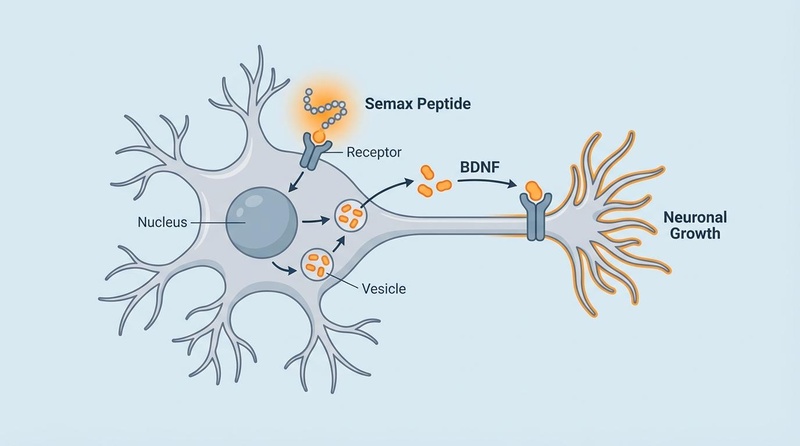
Semax exhibits pleiotropic neuroprotective and nootropic effects through several distinct mechanisms.
¶ Neurotrophic Factor Upregulation
A primary mechanism is the rapid and sustained upregulation of neurotrophins.
- BDNF and NGF: Administration of Semax leads to a rapid increase in Brain-Derived Neurotrophic Factor (BDNF) and Nerve Growth Factor (NGF) levels in the hippocampus, frontal cortex, and retina[3][4].
- TrkB Activation: It increases the expression and phosphorylation of TrkB receptors (the primary receptor for BDNF), facilitating synaptic plasticity and neuronal survival[5].
¶ Neurotransmitter Modulation
Semax modulates the metabolism of monoamines involved in cognition and mood.
- Dopamine and Serotonin: It increases the turnover and levels of dopamine and serotonin in the striatum and other brain regions, which may underlie its effects on focus and mood[6].
- Enkephalinase Inhibition: The peptide inhibits enzymes that degrade enkephalins, potentially contributing to analgesic and anxiolytic effects[1:1].
¶ Gene Expression and Neuroprotection
Transcriptome analysis reveals that Semax affects the expression of genes related to the immune response and vascular system.
- Ischemia Protection: In models of stroke, it suppresses pro-inflammatory genes and activates genes involved in neurotransmission and vascular stabilization, reducing infarct volume and reperfusion injury[7].
- Oxidative Stress: It helps maintain the activity of endogenous antioxidant enzymes (SOD, catalase) during hypoxia[8].
¶ Clinical Indications
In Russia and Ukraine, Semax is a registered pharmaceutical included in the List of Vital & Essential Drugs.
¶ Ischemic Stroke and TIA
Semax is indicated for the acute treatment and rehabilitation of ischemic stroke. Clinical trials have demonstrated that high-dose intranasal administration (1% solution) can:
- Reduce the volume of ischemic damage.
- Accelerate the restoration of focal neurological functions.
- Improve functional outcomes (e.g., Barthel Index scores) compared to placebo[9].
¶ Optic Nerve Disease
The peptide is used in ophthalmology to treat optic nerve atrophy and glaucomatous optic neuropathy. It has been shown to improve visual acuity and expand visual fields, likely by protecting retinal ganglion cells from degeneration[10].
¶ Cognitive Impairment
Semax is prescribed for dyscirculatory encephalopathy and cognitive decline associated with vascular insufficiency or traumatic brain injury (TBI). It aids in the restoration of memory and attention in patients with organic brain lesions[2:1].
¶ ADHD
While less established than its stroke indications, Semax has been investigated for Attention Deficit Hyperactivity Disorder (ADHD). One study in children suggested efficacy comparable to piracetam in improving attention and motor control, with a potentially better safety profile[11].
¶ Nootropic and Off-Label Use
In the biohacking and nootropic communities, Semax is used for cognitive enhancement in healthy individuals.
- Memory: Users report improved acquisition and retention of new information.
- Focus: It is described as providing "clean" stimulation and mental clarity, distinct from the "jittery" energy of amphetamines.
- Mood: Some users report anxiolytic and antidepressant effects, likely mediated by enkephalin and monoamine modulation.
¶ Pharmacokinetics
- Administration: Intranasal administration is the standard route, allowing direct transport to the CNS via olfactory and trigeminal neural pathways, bypassing the blood-brain barrier to some extent[12].
- Absorption: Approximately 60-70% bioavailability via the intranasal route.
- Half-Life vs. Duration: The plasma half-life is short (minutes) due to enzymatic breakdown, but the therapeutic effects persist for 12–24 hours. This dissociation is due to the peptide's triggering of long-lasting gene expression and protein synthesis cascades[3:1].
¶ Dosage and Administration
Semax is typically available in two concentrations: 0.1% (1 mg/mL) and 1.0% (10 mg/mL).
¶ Clinical Protocols (Russia)
- Ischemic Stroke: 1% solution. 3–4 drops per nostril, 3–4 times daily (12–18 mg/day) for 10 days[9:1].
- Optic Nerve/Cognitive: 0.1% solution. 2–3 drops per nostril, 2–3 times daily (600–900 mcg/day) for 7–10 days.
¶ Nootropic Protocols
- Standard Dose: 2–3 drops of 0.1% solution in each nostril, once or twice daily.
- Total Daily Dose: 400 mcg to 1,000 mcg (1 mg).
- Cycling: Commonly used in cycles of 10–14 days, followed by a break, to maintain efficacy and prevent tolerance.
¶ Safety and Side Effects
Semax is generally considered to have a favorable safety profile.
- Side Effects: The most common side effect is mild irritation of the nasal mucosa. It does not typically cause the cardiovascular stress (increased heart rate, blood pressure) associated with traditional stimulants.
- Contraindications: Pregnancy, lactation, and history of acute psychosis or convulsions.
- Interactions: May potentiate the effects of other dopaminergic stimulants. Intranasal vasoconstrictors should be avoided as they impair absorption.
¶ Evidence Quality
- Validated (Russia): Efficacy for stroke and optic nerve atrophy is supported by decades of clinical use and trials in Russia.
- Western Status: Semax is not FDA-approved. Western research is largely limited to animal studies confirming its neurotrophic mechanisms. High-quality, large-scale Western RCTs for cognitive enhancement in healthy adults are lacking.
¶ References
Manchenko, D. M., et al. (2010). The Nootropic and Analgesic Effects of Semax Given via Different Routes. Neuroscience and Behavioral Physiology, 40(6), 637-641. ↩︎ ↩︎
Koroleva, S. V., & Myasoedov, N. F. (2018). Semax as a Universal Drug for Therapy and Research. Biology Bulletin, 45, 589–600. ↩︎ ↩︎
Dolotov, O. V., et al. (2006). The Heptapeptide SEMAX stimulates BDNF Expression in Different Areas of the Rat Brain in vivo. Brain Research, 1117(1), 54-60. ↩︎ ↩︎
Agapova, T. Y., et al. (2008). Effect of Semax on the expression of nerve growth factor and its receptors in the rat brain. Neuroscience and Behavioral Physiology, 38, 923–927. ↩︎
Firstova, Y. Y., et al. (2009). The effects of semax on the expression of the BDNF gene and the gene for its receptor trkB in the rat brain. Neurochemical Journal, 3, 226–231. ↩︎
Eremin, K. O., et al. (2005). Semax, an ACTH(4-10) analogue with neuroprotective properties: effects on dopamine and serotonin metabolism in the rat striatum. Neurochemical Research. ↩︎
Filippenkov, I. B., et al. (2020). Brain Protein Expression Profile Confirms the Protective Effect of the ACTH(4–7)PGP Peptide (Semax) in a Rat Model of Cerebral Ischemia–Reperfusion. International Journal of Molecular Sciences, 21(15), 5444. ↩︎
Panickar, K. S., & Polunin, G. S. (2000). Neuroprotective effects of Semax. Journal of Neurochemistry. ↩︎
Gusev, E. I., et al. (2001). Efficiency of Semax in Acute Ischemic Stroke. Zhurnal Nevrologii i Psikhiatrii imeni S.S. Korsakova, 101(11), 35-40. ↩︎ ↩︎
Polunin, G. S., et al. (2000). Efficiency of Semax in Optic Nerve Disease. Vestnik Oftalmologii, 116(1), 15-18. ↩︎
Tsai, S. J. (2007). Semax, an analogue of adrenocorticotropin (4-10), is a potential agent for the treatment of attention-deficit hyperactivity disorder and Rett syndrome. Medical Hypotheses, 68(5), 1144-1146. ↩︎
Balysheva, T. S., et al. (2001). Intranasal delivery of Semax to the brain. Pharmaceutical Chemistry Journal, 35, 263–265. ↩︎