¶ Vesugen: Benefits, Dosage, & Side Effects
| Sequence | Lys-Glu-Asp (KED) |
| Formula | C15H26N4O8 |
| Category | Synthetic Bioregulator (Cytogen) |
| Source | Synthetic (based on vascular extract) |
| Admin | Oral, Sublingual, SubQ |
| Primary Target | Vascular Endothelium |
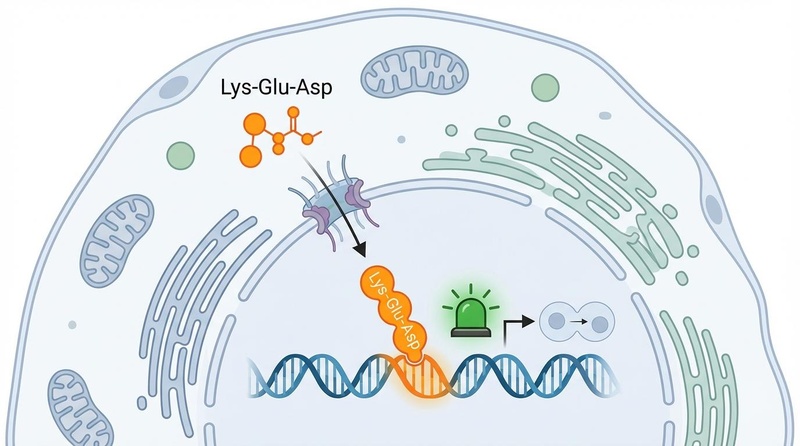
Vesugen is a synthetic tripeptide (Lys-Glu-Asp) designed to regenerate the vascular endothelium and restore blood vessel elasticity. As a "Khavinson bioregulator," it acts as an epigenetic switch, specifically triggering genes responsible for vascular cell proliferation and intercellular communication. It is widely used in Eastern Europe for atherosclerosis and hypertension and is increasingly adopted in longevity circles for maintaining vascular age and supporting cognitive function through improved blood flow.
¶ At a Glance
Aliases
- KED peptide
- Lys-Glu-Asp
- Vessel bioregulator
- Synthesized peptide complex AC-2
Key Points
- Primary Benefit: Restores vascular wall integrity and endothelial function, potentially reversing early signs of atherosclerosis and arterial stiffness.
- Mechanism: Penetrates the cell nucleus and binds to specific DNA promoter regions to upregulate Ki-67 (cell proliferation) and connexin (cell-to-cell communication) in vascular tissues.
- Synergy: Forms the vascular foundation of many bioregulator protocols; frequently stacked with Pinealon for cognitive performance and Ventfort for comprehensive vascular repair.
- Safety: Excellent safety profile with no reported serious adverse effects in over two decades of clinical application in Russia.
What People Use It For
- Reversing or preventing atherosclerosis and arterial plaque buildup.
- Managing hypertension and reducing vascular age.
- Improving microcirculation in conditions like diabetic angiopathy or Raynaud's.
- Enhancing cognitive function by optimizing cerebral blood flow (often with Pinealon).
- Treating varicose veins and hemorrhoids by strengthening vessel walls.
Evidence Quality: Moderate. While extensively studied in Russian clinical trials and practice for over 20 years, it lacks large-scale, Western, double-blind randomized controlled trials (RCTs).
¶ Protocol & Usage
The standard course for synthetic bioregulators is short and intensive.
- Oral (Capsules): 1–2 capsules (100–200 mcg active peptide) daily.
- Timing: 15–30 minutes before meals, preferably in the morning.
- Duration: 10–30 days.
- Frequency: Repeat every 4–6 months for prevention, or every 3 months for therapeutic purposes.
For cognitive enhancement ("Nootropic" effect):
- Vesugen: 2 capsules AM (to improve cerebral blood flow).
- Pinealon: 2 capsules AM (to regenerate neural tissue).
- Cycle: 20 days on, 10 days off.
¶ Legal & Regulatory Status
⚠️ CRITICAL INFORMATION
Regulatory Classification
- United States: Vesugen is not FDA-approved for any medical condition. It is available as a dietary supplement or research chemical.
- Russia & CIS: Registered as a food supplement (Cytogen class) and widely used in clinical practice for cardiovascular conditions.
- WADA Status: Not explicitly listed on the WADA Prohibited List, but athletes should exercise caution with any non-approved substance.
Source Quality Considerations
- Authenticity: Genuine Vesugen is often sold under the "Cytogen" brand (oral capsules) or as "Synthesized Peptide Complex AC-2".
- Research Grade: Lyophilized vials sold by research chemical vendors are for laboratory use only and lack regulatory oversight for purity or sterility.
¶ What is Vesugen?
Vesugen is a synthetic tripeptide consisting of the amino acids Lysine, Glutamic acid, and Aspartic acid (Lys-Glu-Asp). It belongs to the Cytogen class of Khavinson bioregulators—short, synthesized peptides designed to mimic the active sites of complex natural peptide extracts (Cytomaxes).
Origin & Development
Developed by Professor Vladimir Khavinson at the St. Petersburg Institute of Bioregulation and Gerontology, Vesugen was created by analyzing the polypeptide structure of Ventfort (a natural extract from young animal blood vessels). Researchers identified the specific 3-amino acid sequence responsible for the extract's regenerative effects and synthesized it.
The "Short Peptide" Advantage
As a tripeptide, Vesugen is extremely stable and small enough to be:
- Orally Bioavailable: It resists degradation by gastrointestinal peptidases.
- Cell-Permeable: It easily crosses cell membranes and the nuclear envelope to interact directly with DNA.
- Non-Immunogenic: It does not trigger an immune response or antibody formation.
¶ How Does Vesugen Work?
Vesugen operates via epigenetic regulation (peptide-DNA interactions), a mechanism distinct from typical pharmaceutical drugs that block receptors or enzymes.
¶ 1. Epigenetic Activation of Vascular Regeneration
Vesugen penetrates the nucleus of endothelial cells and binds to specific binding sites in the promoter regions of genes.
- Specific Target: Research has identified that Vesugen (KED) binds to the specific sequence
5'-AGCCTCAACCATCAGGAAAACAAGAGT-3'in the promoter region of the MKI67 gene[1]. - Effect: This binding upregulates the expression of the Ki-67 protein, a key marker of cell proliferation. This stimulates the renewal of the vascular endothelium (the inner lining of blood vessels), replacing senescent or damaged cells.
¶ 2. Restoration of Intercellular Communication
Vesugen increases the expression of connexin, a protein that forms gap junctions between cells.
- Gap Junctions: These channels allow cells to exchange ions and signaling molecules.
- Effect: Improved synchronization of vascular smooth muscle contraction and relaxation, leading to better regulation of vascular tone and blood pressure.
¶ 3. Normalization of Endothelin-1
Studies suggest Vesugen helps normalize the expression of Endothelin-1 (ET-1), a potent vasoconstrictor. In atherosclerosis, ET-1 is often elevated, causing vessels to constrict and stiffen. By regulating ET-1, Vesugen helps restore natural vasodilation.
¶ Main Benefits & Clinical Applications
¶ 1. Atherosclerosis and Arterial Health
Atherosclerosis involves chronic inflammation and damage to the endothelial lining. Vesugen targets this root cause.
- Clinical Data: In patients with atherosclerosis of the heart, brain, and lower limbs, Vesugen has been shown to improve lipid metabolism (reducing lipid peroxidation products) and reduce arterial stiffness[2].
- Outcome: Patients report improved circulation (warmer hands/feet), reduced frequency of angina attacks, and better exercise tolerance.
¶ 2. Hypertension and Vascular Tone
By repairing the endothelium—the organ responsible for producing nitric oxide (NO)—Vesugen helps restore the vessel's natural ability to dilate.
- Mechanism: Healthy endothelial cells produce adequate NO to relax vascular smooth muscle.
- Result: Gradual normalization of blood pressure, often allowing for a reduction in conventional antihypertensive medication dosage (under medical supervision).
¶ 3. Cognitive Function (The "Vascular-Nootropic" Effect)
The brain is the most energy-demanding organ and relies entirely on microcirculation.
- Synergy: When improved blood flow delivers more oxygen and glucose to neurons, cognitive performance improves.
- Research: A study on elderly patients with "organic brain syndrome" showed that the combination of Vesugen and Pinealon significantly improved memory and attention compared to controls[3][4].
- Protocol: The "Pinealon + Vesugen" stack is famous for enhancing focus, memory, and reaction time by combining direct neuro-regeneration (Pinealon) with improved fuel delivery (Vesugen).
¶ 4. Venous Insufficiency and Varicose Veins
While arteries carry blood away, veins return it. Vesugen supports the integrity of venous walls as well.
- Application: Used to reduce edema (swelling), pain, and heaviness in the legs associated with varicose veins or thrombophlebitis.
¶ Synergy: The Khavinson Protocol
Vesugen is rarely used in isolation. In the Khavinson system, peptides are stacked to address systems holistically.
¶ The "Vascular-Brain" Stack (Cognition & Focus)
- Components: Vesugen (Vessels) + Pinealon (Brain).
- Rationale: Vesugen improves blood flow to the brain; Pinealon regenerates brain cells.
- User Feedback: Highly rated for "clearing brain fog," improving reaction time in athletes, and managing high-stress periods.
¶ The "Comprehensive Vascular" Stack (Repair & Maintenance)
- Components: Vesugen (Synthetic) + Ventfort (Natural).
- Rationale:
- Vesugen acts fast (within hours/days) to trigger gene expression and jumpstart repair.
- Ventfort provides a broader range of natural peptides for sustained, long-term nutritional support of the vascular tissue.
- Protocol: Often Vesugen is used for an initial 10-20 day intensive course, followed by Ventfort for maintenance.
¶ The "Longevity Trinity" (General Anti-Aging)
- Components: Endoluten (Neuroendocrine) + Vladonix (Immune) + Vesugen/Ventfort (Vascular).
- Rationale: Targets the three pillars of aging—Hormonal decline, Immune senescence, and Vascular stiffening.
¶ Safety and Side Effects
Side Effects
- Oral: Virtually no reported side effects. Occasional mild digestive upset (rare).
- Injection: Mild redness or irritation at the injection site.
- Systemic: No toxicity, mutagenicity, or accumulation has been observed in long-term studies.
Contraindications
- Pregnancy & Breastfeeding: Not studied; avoid as a precaution.
- Individual Intolerance: Rare hypersensitivity to capsule fillers (e.g., lactose in some brands).
¶ Practical FAQ
1. How quickly does Vesugen work?
As a synthetic "Cytogen," Vesugen is fast-acting. Users often report subjective improvements in circulation (e.g., warmer extremities) within 3–5 days. Cellular repair mechanisms (Ki-67 activation) begin almost immediately upon nuclear entry.
2. Can I take Vesugen with blood pressure medication?
Yes, it is often used adjunctively. However, because Vesugen improves vascular tone and may naturally lower blood pressure, you should monitor your BP closely. You may eventually need to lower your medication dose under a doctor's supervision.
3. Is Vesugen the same as Ventfort?
No.
- Vesugen is a synthetic tripeptide (Lys-Glu-Asp). It is a precise, fast-acting signal.
- Ventfort is a natural peptide complex extracted from young animal aorta. It contains a broader mix of peptides and is slower-acting but provides "raw material" for the vessels.
- Best Practice: Use Vesugen for acute/fast repair, Ventfort for long-term maintenance.
4. Is Vesugen the same as Livagen?
No.
- Vesugen: Lys-Glu-Asp (Tripeptide). Focus: Vascular endothelium.
- Livagen: Lys-Glu-Asp-Ala (Tetrapeptide). Focus: Liver, pancreas, and immune system.
- Confusingly, they share the first three amino acids, but the addition of Alanine in Livagen alters its target specificity.
¶ References
Khavinson, V. K., et al. (2014). "Epigenetic aspects of peptidergic regulation of vascular endothelial cell proliferation during aging." Advances in Gerontology. https://pubmed.ncbi.nlm.nih.gov/25051766/ ↩︎
Khavinson, V. K. (2002). "Peptides, Genome, and Aging." Publishing House Nauka. ↩︎
Khavinson, V. K., et al. (2021). "Peptide KED: Molecular-Genetic Aspects of Neurogenesis Regulation in Alzheimer's Disease." Bulletin of Experimental Biology and Medicine. https://pubmed.ncbi.nlm.nih.gov/34173097/ ↩︎
Khavinson, V. K., et al. (2015). "Effect of synthetic peptides on aging of patients with chronic polymorbidity and organic brain syndrome of the central nervous system in remission." Advances in Gerontology. https://pubmed.ncbi.nlm.nih.gov/26390612/ ↩︎