¶ Blood-Based Interventions for Longevity
Blood-based interventions represent a promising frontier in regenerative medicine, targeting aging through plasma manipulation, cellular rejuvenation, and removal of age-related blood factors. These approaches include therapeutic plasma exchange, platelet-rich plasma (PRP) therapy, and experimental young blood transfusions. Emerging evidence suggests these interventions work through shared mechanisms involving cellular senescence reduction, inflammatory pathway modulation, and growth factor optimization.
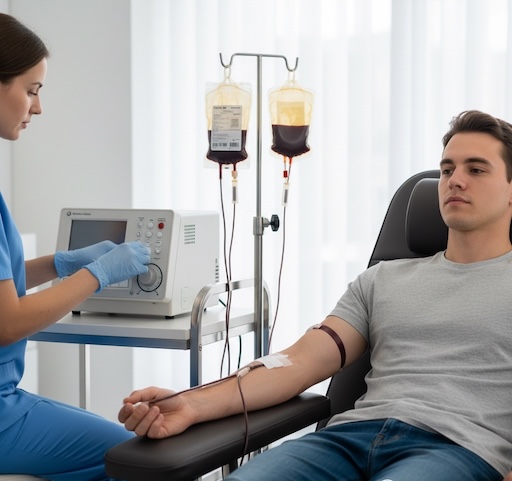
Note: Parabiosis and “young blood” transfusion are historical/experimental concepts. They are not practical or actionable for patients today and are research-only practices that should not be pursued as therapies.
¶ Overview and Rationale
Blood serves as the body's communication highway, carrying hormones, growth factors, inflammatory molecules, and cellular debris that directly influence cellular senescence and aging processes.[1][2]
As we age, blood accumulates harmful substances including pro-inflammatory cytokines, senescence-associated secretory phenotype (SASP) factors, and toxic metabolites that accelerate cellular aging and organ dysfunction through mechanisms of inflammaging.[3][4]
Parabiosis experiments in mice have demonstrated that young blood can rejuvenate old organs while old blood accelerates aging in young animals, providing the fundamental rationale for blood-based longevity interventions.[5][6]
Recent studies have identified specific age-imposed systemic molecular excesses in blood that drive aging, suggesting targeted removal or replacement strategies could restore youthful function.[7][8]
¶ Types of Blood-Based Interventions
Therapeutic Plasma Exchange (TPE) involves removing aged plasma and replacing it with albumin or saline solutions, effectively diluting harmful age-related factors while preserving beneficial cellular components.[9][10]
Platelet-Rich Plasma (PRP) therapy concentrates autologous platelets to deliver high concentrations of growth factors and anti-aging proteins directly to target tissues.[11][12]
Young blood transfusion or heterochronic parabiosis involves direct transfer of young plasma to older individuals, though this approach remains largely experimental and controversial.[13][14]
¶ Apheresis Technologies
Apheresis technologies involve the selective removal of specific blood components while returning the rest to the patient. In longevity applications, these methods focus on reducing age-related harmful factors while preserving beneficial components.
¶ Types of Apheresis
- Therapeutic plasma exchange (TPE): Removes and replaces plasma
- Selective apheresis: Targets specific harmful factors
- Cellular apheresis: Removes specific cell types
- Lipoprotein apheresis: Removes cholesterol and lipids
¶ Mechanisms of Action
Apheresis may promote longevity through:
- Removal of senescent cell factors
- Elimination of inflammatory cytokines
- Reduction of harmful metabolites
- Restoration of beneficial plasma components
- Immune system modulation
¶ Clinical Applications
Current and exploratory uses include:
- Therapeutic plasma exchange for longevity
- Selective removal of aging factors
- Combination with other therapies
- Research applications
¶ Technology Development
Emerging technologies aim for:
- More selective factor removal
- Improved safety profiles
- Reduced procedure time
- Better patient comfort
- Cost reduction
¶ Fringe and Historical Concepts
¶ Parabiosis (historical research model)
Surgically connecting the circulatory systems of two animals demonstrated that circulating factors influence tissue aging and regeneration. Parabiosis informed the rationale for modern blood-based approaches but is not a clinical therapy and has no direct human application.
¶ “Young blood” transfusion (experimental, not recommended)
Inspired by parabiosis findings, infusing plasma from young donors into older recipients has not shown proven anti-aging benefits in humans. U.S. regulators advise against this practice outside clinical trials due to insufficient evidence and potential risks.[15]
Emerging approaches include targeted removal of specific aging factors, extracellular vesicle therapy, and engineered blood factor replacements that avoid the need for donor blood.[16][17]
¶ Shared Mechanisms
All blood-based interventions target inflammaging - the chronic low-grade inflammation characteristic of aging driven by accumulated damage and senescent cell secretions.[18][19]
These approaches modulate growth factor signaling pathways including insulin-like growth factor (IGF), vascular endothelial growth factor (VEGF), and fibroblast growth factors that regulate cell growth, angiogenesis, and tissue repair, which are key in regenerative medicine.[20][21]
Blood interventions address cellular senescence by removing SASP factors while potentially delivering pro-regenerative signals that promote cellular repair and renewal.[22][23]
Shared mechanisms include restoration of mitochondrial function, improvement of stem cell activity, and rebalancing of immune system responses that become dysregulated with age, potentially leveraging principles from regenerative medicine.[24][25]
¶ Comparative Evidence
Therapeutic plasma exchange has shown the strongest clinical evidence, with recent studies demonstrating biological age reduction of 2.6 years and improvements across multiple epigenetic aging clocks.[26][27]
PRP therapy shows mixed results with moderate efficacy for cosmetic applications like facial rejuvenation, but limited evidence for systemic anti-aging effects.[28][29]
Young blood transfusion studies in rodents consistently show lifespan extension and organ rejuvenation, but human clinical evidence remains limited and safety concerns persist.[30][31]
Plasma dilution approaches suggest that removing harmful factors may be more important than adding beneficial ones, with simple albumin replacement showing rejuvenating effects.[32][33]
¶ Safety Considerations
Blood-based interventions carry inherent risks including infection transmission, immune reactions, and cardiovascular complications that require careful medical oversight.[34][35]
Long-term safety data is limited for most approaches, particularly regarding repeated treatments and potential disruption of normal physiological processes.[36][37]
Regulatory concerns exist around unproven anti-aging applications, with the FDA issuing warnings about young plasma therapies lacking rigorous safety testing.[15:1][38]
Standardization challenges persist across all blood-based interventions, with significant variations in protocols, preparation methods, and quality control measures affecting both safety and efficacy.[39][40]
¶ Future Directions
Research is focused on identifying specific beneficial and harmful blood factors to enable targeted interventions without requiring whole blood or plasma transfer.[41][42]
Synthetic and engineered approaches including artificial blood substitutes and targeted senolytic drugs may provide safer alternatives to biological blood-based therapies.[43][44]
Personalized blood-based interventions using individual biomarker profiles and multi-omics analysis could optimize treatment protocols and improve outcomes.[45][46]
Combination approaches integrating blood-based interventions with other longevity strategies like caloric restriction, exercise, and pharmaceutical interventions show promise for synergistic effects.[47][48]
¶ See also
- Platelet Rich Plasma Longevity
- Therapeutic Plasma Exchange
- Cellular Senescence Interventions
- Inflammaging Biomarkers
¶ References
Aging insights from heterochronic parabiosis models — https://www.nature.com/articles/s41514-024-00166-0 ↩︎
Molecular mechanisms of aging and anti-aging strategies — https://biosignaling.biomedcentral.com/articles/10.1186/s12964-024-01663-1 ↩︎
Connecting aging biology and inflammation in the omics era — https://www.jci.org/articles/view/158448 ↩︎
Inflammation, epigenetics, and metabolism converge to cell senescence and ageing: the regulation and intervention — https://www.nature.com/articles/s41392-021-00646-9 ↩︎
Can You Reverse Aging With a Transfusion of Young Blood? — https://www.popularmechanics.com/science/health/a61207150/young-blood-transfusions/ ↩︎
Young Blood Rejuvenates Old Bodies: A Call for Reflection when Moving from Mice to Men — https://pmc.ncbi.nlm.nih.gov/articles/PMC5836258/ ↩︎
Multi‐Omics Analysis Reveals Biomarkers That Contribute to Biological Age Rejuvenation in Response to Single‐Blinded Randomized Placebo‐Controlled Therapeutic Plasma Exchange — https://onlinelibrary.wiley.com/doi/10.1111/acel.70103 ↩︎
Will Revitalizing Old Blood Slow Aging? — https://www.cuimc.columbia.edu/news/will-revitalizing-old-blood-slow-aging ↩︎
Old plasma dilution reduces human biological age: a clinical study — https://pubmed.ncbi.nlm.nih.gov/35999337/ ↩︎
Human clinical trial of plasmapheresis effects on biomarkers of aging (efficacy and safety trial) — https://pmc.ncbi.nlm.nih.gov/articles/PMC12218284/ ↩︎
The Well-Forgotten Old: Platelet-Rich Plasma in Modern Anti-Aging Therapy — https://pmc.ncbi.nlm.nih.gov/articles/PMC11545519/ ↩︎
Anti-Aging Potential of Platelet Rich Plasma (PRP): Evidence from Osteoarthritis (OA) and Applications in Senescence and Inflammaging — https://pmc.ncbi.nlm.nih.gov/articles/PMC10451843/ ↩︎
Rejuvenation of young blood on aging organs: Effects, circulating factors, and mechanisms — https://www.sciencedirect.com/science/article/pii/S2405844024086833 ↩︎
The science of young blood transfusions: can blood rejuvenate? — https://www.drugdiscoverynews.com/young-blood-reverses-aging-in-old-organs-15945 ↩︎
FDA warnings about young plasma therapies — https://www.popularmechanics.com/science/health/a61207150/young-blood-transfusions/ ↩︎ ↩︎
Research progress on blood therapy for anti-aging — https://www.sciencedirect.com/science/article/pii/S2090123225005685 ↩︎
Young Plasma Rejuvenates Blood DNA Methylation Profile, Extends Mean Lifespan, and Improves Physical Appearance in Old Rats — https://pmc.ncbi.nlm.nih.gov/articles/PMC11020299/ ↩︎
Immunosenescence: molecular mechanisms and diseases — https://www.nature.com/articles/s41392-023-01451-2 ↩︎
Cellular Senescence and Ageing: Mechanisms and Interventions — https://www.frontiersin.org/journals/aging/articles/10.3389/fragi.2022.866718/full ↩︎
Aging and aging-related diseases: from molecular mechanisms to interventions and treatments — https://www.nature.com/articles/s41392-022-01251-0 ↩︎
Human Aging and Age-Related Diseases: From Underlying Mechanisms to Pro-Longevity Interventions — https://www.aginganddisease.org/EN/10.14336/AD.2024.0280 ↩︎
Targeting Cellular Senescence in Aging and Age-Related Diseases: Challenges, Considerations, and the Emerging Role of Senolytic and Senomorphic Therapies — https://www.aginganddisease.org/EN/10.14336/AD.2024.0206 ↩︎
Aging Hallmarks and Progression and Age-Related Diseases: A Landscape View of Research Advancement — https://pubs.acs.org/doi/10.1021/acschemneuro.3c00531 ↩︎
Senescence and aging: Causes, consequences, and therapeutic avenues — https://rupress.org/jcb/article/217/1/65/39207/Senescence-and-aging-Causes-consequences-and ↩︎
Therapeutic plasma exchange (TPE) and blood products – Implications for longevity and disease — https://www.trasci.com/article/S1473-0502(21)00129-4/fulltext ↩︎
Multi‐Omics Analysis Reveals Biomarkers That Contribute to Biological Age Rejuvenation in Response to Therapeutic Plasma Exchange — https://onlinelibrary.wiley.com/doi/10.1111/acel.70103 ↩︎
Young Blood & Longevity: Therapeutic Plasma Exchange (TPE) Treatments — https://www.diamandis.com/blog/young-blood-and-longevity-tpe ↩︎
Use of platelet rich plasma for skin rejuvenation — https://onlinelibrary.wiley.com/doi/10.1111/srt.13714 ↩︎
Platelet-rich Plasma use for facial rejuvenation: a clinical trial and review of current literature — https://pmc.ncbi.nlm.nih.gov/articles/PMC8182581/ ↩︎
Rejuvenation of young blood on aging organs: Effects, circulating factors, and mechanisms — https://pubmed.ncbi.nlm.nih.gov/38994040/ ↩︎
Young blood transfusion - Wikipedia — https://en.wikipedia.org/wiki/Young_blood_transfusion ↩︎
Dr. Dobri Kiprov: The Science Behind Plasma Exchange for Longevity — https://beingpatient.com/dobri-kiprov-plasma-exchange-longevity-science/ ↩︎
Plasma Exchange for Longevity — https://yuniquemedical.com/plasma-exchange-for-longevity/ ↩︎
Therapeutic efficacy and safety of plasmapheresis in elderly patients with neuromyelitis optica spectrum disorder: a single-center observational study — https://pmc.ncbi.nlm.nih.gov/articles/PMC10041617/ ↩︎
Platelet-Rich Plasma (PRP) Injections — https://www.hopkinsmedicine.org/health/treatment-tests-and-therapies/plateletrich-plasma-prp-treatment ↩︎
Study of Efficacy and Safety of the Plasmapheresis Method — https://clinicaltrials.gov/study/NCT04897113 ↩︎
A systematic review of the safety and effectiveness of platelet-rich plasma (PRP) for skin aging — https://pubmed.ncbi.nlm.nih.gov/31628542/ ↩︎
Young Blood Rejuvenates Old Bodies: A Call for Reflection when Moving from Mice to Men — https://pmc.ncbi.nlm.nih.gov/articles/PMC5836258/ ↩︎
A comprehensive review of platelet-rich plasma for the treatment of dermatologic disorders — https://www.tandfonline.com/doi/full/10.1080/09546634.2022.2142035 ↩︎
Platelet Rich Plasma Injections - Standardization Challenges — https://oxfordnatural.clinic/platelet-rich-plasma/ ↩︎
Research progress on blood therapy for anti-aging - Future Directions — https://www.sciencedirect.com/science/article/pii/S2090123225005685 ↩︎
Will Revitalizing Old Blood Slow Aging? - Future Research — https://www.cuimc.columbia.edu/news/will-revitalizing-old-blood-slow-aging ↩︎
Senolytic and Senomorphic Therapies - Synthetic Approaches — https://www.aginganddisease.org/EN/10.14336/AD.2024.0206 ↩︎
Aging interventions and treatments - Synthetic Biology — https://www.nature.com/articles/s41392-022-01251-0 ↩︎
Multi‐Omics Analysis for Personalized Blood-Based Interventions — https://onlinelibrary.wiley.com/doi/10.1111/acel.70103 ↩︎
Personalized Anti-Aging Strategies — https://biosignaling.biomedcentral.com/articles/10.1186/s12964-024-01663-1 ↩︎
Pro-Longevity Interventions - Combination Approaches — https://www.aginganddisease.org/EN/10.14336/AD.2024.0280 ↩︎
Integrated aging interventions targeting multiple pathways — https://www.nature.com/articles/s41392-021-00646-9 ↩︎