¶ SHLP-2
¶ At a Glance
What is it?
SHLP-2 (Small Humanin-Like Peptide 2) is a 26-amino acid peptide naturally encoded within the mitochondrial DNA. Like its "cousin" Humanin, it is a "mitokine"—a signal sent by mitochondria to the rest of the body to regulate metabolism and protect cells from stress.
Primary Benefits
- Metabolic Regulation: Enhances insulin sensitivity and promotes fat burning (thermogenesis) by acting on the brain.
- Neuroprotection: Protects neurons from toxicity associated with Parkinson's and Alzheimer's disease.
- Cellular Defense: Acts as a chaperone to prevent the formation of toxic amyloid plaques.
Quick Verdict
SHLP-2 is a promising experimental peptide that appears to function as a potent regulator of energy homeostasis and a guardian against age-related degeneration. While human data is limited to observational studies, preclinical evidence suggests it may offer unique metabolic benefits distinct from other mitochondrial peptides.
¶ Safety & Status
SHLP-2 is a naturally occurring peptide in humans. Therapeutic use is currently in the preclinical research stage. No FDA-approved drugs exist.
- Status: Investigational (Not approved for human therapeutic use).
- Cancer Risk: Unlike some growth factors, higher endogenous levels of SHLP-2 have been associated with a reduced risk of prostate cancer in observational studies, suggesting a potentially safer profile than general growth agonists.
¶ Protocol & Dosage
Note: The following information is derived exclusively from preclinical (animal) studies and theoretical extrapolation. There are no established human clinical protocols.
¶ Research Protocols (Extrapolated)
- Systemic: Animal studies have used systemic injections effectively. Equivalent human doses are speculative but would likely fall in the microgram range typical for potent peptides (e.g., 2-5 mg/week equivalent).
- Timing: Due to its role in energy expenditure, administration mimicking natural circadian rhythms (morning) is theoretically preferable.
¶ Administration
- Method: Subcutaneous injection is the standard for peptide research.
- Stability: As a mitochondrial peptide, SHLP-2 is relatively stable but should be stored lyophilized at -20°C.
- Reconstitution: Standard bacteriostatic water.
¶ Benefits & Effects
¶ 1. Metabolic Health & Weight Loss
SHLP-2 has emerged as a potent regulator of whole-body metabolism. In diet-induced obese mice, SHLP-2 treatment prevented weight gain and improved insulin sensitivity.
- Mechanism: It acts centrally in the hypothalamus to suppress hunger and peripherally to increase thermogenesis (heat production) in brown adipose tissue[1].
- Result: Reduced fat mass and improved glucose handling without muscle loss.
¶ 2. Neuroprotection (Parkinson's & Alzheimer's)
SHLP-2 exhibits strong cytoprotective properties in the brain.
- Parkinson's: It protects dopamine-producing neurons from toxicity. A specific natural variant (K4R-SHLP2) was found to be even more potent than the standard form in preventing neuronal death[2].
- Alzheimer's: Like Humanin, SHLP-2 can bind to misfolded proteins (amyloids), preventing them from aggregating into toxic plaques that kill neurons[3].
¶ 3. Eye Health (Macular Degeneration)
Mitochondrial dysfunction is a key driver of Age-Related Macular Degeneration (AMD).
- Evidence: In retinal pigment epithelial cells (the cells that die in AMD), SHLP-2 restored mitochondrial function and prevented cell death induced by oxidative stress[4].
¶ The Reality Check
Expectations vs. Reality
- Human Data Gap: Almost all functional data comes from mice and cell cultures. While humans produce SHLP-2, we do not yet know if injecting it provides the same dramatic metabolic benefits as seen in rodents.
- Availability: Unlike Humanin or MOTS-c, SHLP-2 is less commonly available from grey-market vendors, and purity verification is difficult.
The "Sourcing" Issue
- Sequence Matters: Ensure you are getting the correct 26-amino acid sequence. The potent "K4R" variant (swapping Lysine for Arginine at position 4) is a specific analog that may appear in future research but is likely not the standard offering.
¶ Mechanism of Action
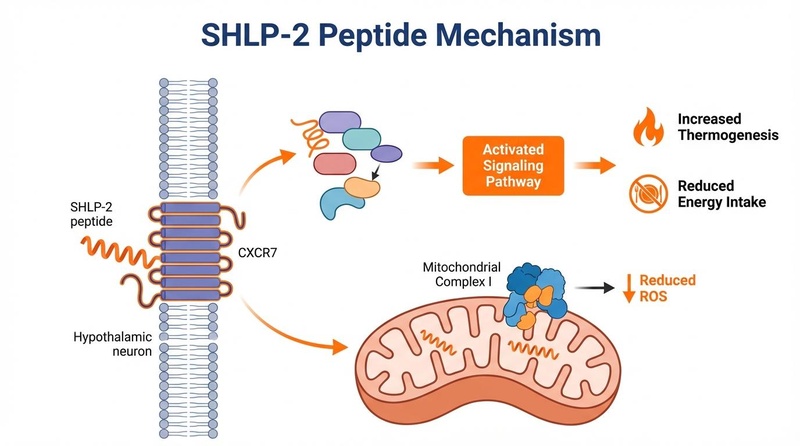
SHLP-2 operates through a unique "dual-action" mechanism, functioning both as a hormone and an intracellular regulator.
¶ 1. The CXCR7 Axis (Metabolic Signaling)
Unlike Humanin (which binds receptors like CNTFR/WSX-1), SHLP-2 has been identified as a specific ligand for the CXCR7 (Chemokine Receptor 7), also known as ACKR3[1:1].
- Pathway: Binding to CXCR7 in the hypothalamus activates the ERK1/2 pathway.
- Effect: This signaling cascade suppresses appetite and activates the sympathetic nervous system to boost energy expenditure in brown fat.
¶ 2. Mitochondrial Chaperone Activity
Inside the cell, SHLP-2 mimics the function of "heat shock proteins" (chaperones).
- Target: It binds directly to misfolding-prone peptides like Amylin (in the pancreas) and Amyloid-beta (in the brain).
- Effect: By "chaperoning" these proteins, it prevents them from forming the toxic fibrils that destroy cells in diabetes and Alzheimer's[3:1].
¶ 3. Mitochondrial Stabilization
SHLP-2 localizes to the mitochondria, where it stabilizes Complex I of the electron transport chain. This improves cellular respiration efficiency and reduces the leakage of damaging free radicals (ROS)[2:1].
¶ Evidence & Research
| Study | Subjects | Findings | Evidence Grade |
|---|---|---|---|
| Kim et al. (2023)[1:2] | Mice (Obese) | Systemic SHLP-2 prevented diet-induced obesity, increased thermogenesis, and improved insulin sensitivity via CXCR7. | High (Animal) |
| Cobb et al. (2016)[2:2] | Neurons (In Vitro) | The K4R variant of SHLP-2 strongly protected neurons from toxin-induced apoptosis (Parkinson's model). | Moderate (Cell) |
| Xiao et al. (2016)[3:2] | Protein Assay | SHLP-2 inhibited the fibrillation of pancreatic amylin, suggesting potential in Type 2 Diabetes prevention. | Moderate (Mechanistic) |
| Cohen et al. (2017)[5] | Humans (Observational) | Higher circulating SHLP-2 levels were associated with a significantly reduced risk of prostate cancer. | Moderate (Human Assoc.) |
¶ Safety, Side Effects & Contraindications
¶ Theoretical Profile
- Endogenous Safety: As a peptide naturally produced by the human body, SHLP-2 is expected to have a low risk of allergic reaction or toxicity at physiological doses.
- Cancer Paradox: While many growth factors increase cancer risk, SHLP-2 levels are negatively correlated with prostate cancer (higher levels = lower risk)[5:1]. However, its anti-apoptotic (cell survival) mechanism means it could theoretically protect existing tumor cells from dying.
¶ Potential Side Effects
- Injection Site Reactions: Redness or irritation (common with all peptides).
- Metabolic Shift: Rapid changes in metabolic rate could theoretically cause transient fatigue or hunger fluctuations.
¶ Comparison: The "Mitochondrial Trinity"
| Feature | SHLP-2 | Humanin | MOTS-c |
|---|---|---|---|
| Primary Target | Hypothalamus & Mitochondria | General Cytoprotection | Muscle & Metabolism |
| Key Receptor | CXCR7 | CNTFR / WSX-1 / FPR2 | Folate Cycle / AMPK (Nuclear) |
| Best For | Weight Control, Neuroprotection | Longevity, Alzheimer's, Cell Survival | Athletic Performance, Insulin Sensitivity |
| Origin | 16S rRNA gene | 16S rRNA gene | 12S rRNA gene |
| Status | Emerging Research | Established Preclinical | Established Preclinical |
¶ References
Kim, S. J., et al. (2023). Mitochondria-derived peptide SHLP2 regulates energy homeostasis through the activation of hypothalamic neurons. Nature Communications, 14, 4668. Link ↩︎ ↩︎ ↩︎
Cobb, L. J., et al. (2016). Naturally occurring mitochondrial-derived peptides are age-dependent regulators of apoptosis, insulin sensitivity, and inflammatory markers. Aging, 8(4), 796–809. Link ↩︎ ↩︎ ↩︎
Xiao, J., et al. (2016). The Mitochondrial-Derived Peptides, HumaninS14G and Small Humanin-like Peptide 2, Exhibit Chaperone-like Activity. Scientific Reports, 7, 8372. Link ↩︎ ↩︎ ↩︎
Nashine, S., et al. (2018). Characterizing the protective effects of SHLP2, a mitochondrial-derived peptide, in macular degeneration. Scientific Reports, 8, 15114. Link ↩︎
Xiao, J., et al. (2017). Low circulating levels of the mitochondrial-peptide hormone SHLP2: novel biomarker for prostate cancer risk. Oncotarget, 8(49), 85984–85993. Link ↩︎ ↩︎