¶ Focus and Cognitive Performance: An Evidence-Based Guide

¶ Overview
Cognitive performance—specifically the ability to maintain focus, process information rapidly, and execute complex tasks—is a primary determinant of professional success and quality of life. While the market is flooded with "brain boosters," true cognitive enhancement follows a hierarchical structure: foundational lifestyle factors provide the necessary neurobiological substrate, while targeted substances and pharmacological agents offer specific, often acute, performance benefits.
This guide synthesizes clinical evidence to provide a roadmap for cognitive optimization, moving from essential biological maintenance to advanced interventions.
¶ 1. Lifestyle Interventions: The Biological Foundation
Before considering supplementation, the brain's physiological needs must be met. Deficits in sleep, metabolic fuel, or neurotrophic signaling render downstream interventions significantly less effective.
¶ Sleep: The Regulator of Attention
Sleep is the critical period for neurotoxin clearance and synaptic homeostasis. Its impact on focus is profound and often underestimated due to the brain's inability to accurately self-assess impairment during deprivation.
- Attentional Stability: Sleep deprivation collapses the brain's temporal integration capabilities. Research on the "attentional blink" shows that 24 hours of sleep deprivation extends the time needed to process sequential visual stimuli from ~200ms to over 600ms, effectively slowing the brain's refresh rate[1].
- Neurophysiological Deficits: The P300 event-related potential, a marker of attentional resource allocation, is significantly delayed by sleep loss. Crucially, individuals with chronic sleep restriction often report feeling "fine" despite objective measurable deficits in reaction time and processing speed, highlighting a dangerous dissociation between perception and performance[2].
- Memory Encoding: Sleep is more critical for the acquisition of new information than for the maintenance of old memories. Meta-analyses show that sleep deprivation before learning induces severe encoding deficits (Hedges’ g = 0.62), making it nearly impossible to retain new complex information effectively[3].
¶ Exercise: BDNF and Synaptic Plasticity
Exercise is arguably the most potent natural stimulus for neuroplasticity, mediated primarily by Brain-Derived Neurotrophic Factor (BDNF).
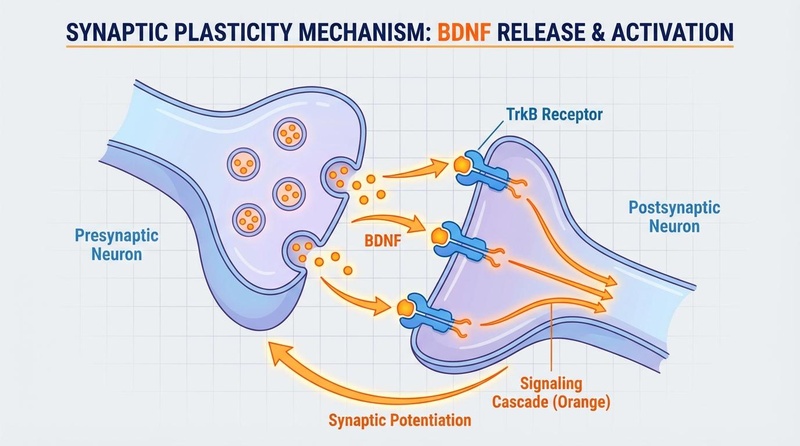
Exercise induces the release of BDNF, which strengthens synaptic connections and supports learning.
- Acute vs. Chronic Effects: A single bout of high-intensity exercise moderately increases BDNF (Hedges’ g = 0.46), priming the brain for learning immediately post-workout. Regular training amplifies this response (Hedges’ g = 0.59), sensitizing the brain to neurotrophic signaling[4].
- The Lactate Shuttle: During high-intensity intervals (HIIT), lactate produced by muscles crosses the blood-brain barrier and triggers BDNF expression in the hippocampus. This mechanism links anaerobic effort directly to improvements in executive function and cognitive inhibition[5][6][7].
¶ Mindfulness: Training the Attention Networks
Mindfulness is a form of cognitive training that targets specific attentional networks, distinct from relaxation.
- Default Mode Network Regulation: The Default Mode Network (DMN) is active during mind-wandering and distractibility. Mindfulness training strengthens the functional "anticorrelation" between the DMN and the task-positive networks, allowing for faster recovery from distractions and greater stability of focus[8][9].
- Clinical Efficacy: Meta-analyses confirm that mindfulness interventions yield reliable improvements in objective attention performance (Hedges’ g = 0.29), particularly in domains of inhibition and conflict monitoring (e.g., ignoring irrelevant stimuli)[10].
¶ Nutrition: Metabolic Regulation
Nutrition impacts cognition through substrate availability and structural support.
- Glucose Regulation: The brain is highly sensitive to glucose fluctuations. Both hypoglycemia and hyperglycemia impair processing speed. Optimal cognitive performance is observed at stable glucose levels, while the "spikes and crashes" associated with high-glycemic diets are detrimental to sustained attention[11].
- Omega-3 Fatty Acids: DHA and EPA are structural components of neuronal membranes. Supplementation (daily doses >500mg) has been shown to improve executive function by up to 26% in older adults, correlated with preserved white matter integrity[12][13].
¶ 2. Common Substances: Optimizing Vigilance
¶ Caffeine + L-Theanine
The combination of Caffeine and L-Theanine is one of the most replicated and effective "stacks" for productivity, leveraging the synergy between two safe compounds.
- Caffeine: Acts as an adenosine receptor antagonist ( and ). By blocking adenosine (which builds up to signal fatigue), it disinhibits dopamine and norepinephrine release, promoting wakefulness and vigilance. However, on its own, it can increase anxiety and vasoconstriction[14].
- L-Theanine: An amino acid found in green tea that increases alpha-brain waves (8–14 Hz), associated with "relaxed alertness." Electrophysiological studies confirm it modulates intersensory selective attention[15].
- Synergy: When combined (typically 100-200mg Caffeine with 200mg L-Theanine), L-Theanine mitigates the jitteriness and blood pressure spike of caffeine while preserving its focus-enhancing effects. Studies show this combination improves accuracy in attention-switching tasks and reduces susceptibility to distraction more effectively than either compound alone[16][17].
¶ 3. Nootropics: Enhanced Processing
¶ Brahmi (Bacopa monnieri)
Brahmi is a traditional herb with robust modern evidence for memory and processing speed.
- Speed of Processing: A meta-analysis of 9 randomized controlled trials found that Bacopa supplementation significantly reduced the time to complete complex cognitive tasks (Trail Making Test Part B) by ~18ms. It specifically enhances attention shifting and choice reaction time[18].
- Mechanism: The active bacosides enhance kinase activity and synaptic restoration, modulating cholinergic systems vital for memory encoding[19]. Note that effects are typically cumulative, requiring 8-12 weeks of supplementation.
¶ Racetams (Phenylpiracetam & Piracetam)
The racetams are a class of synthetic compounds that modulate neurotransmission.
- Phenylpiracetam: A phenylated analog of piracetam, significantly more potent and lipophilic. It acts as a dopamine reuptake inhibitor and nicotinic receptor modulator. It is unique for its psychostimulant properties and ability to increase tolerance to cold and physical stress. Used clinically in Russia, it shows promise for acute performance enhancement, though tolerance can build quickly[20].
- Piracetam: The parent compound, often used for neuroprotection in cognitive decline. Its effects in healthy, young individuals are subtle and less consistent than its derivatives[21].
¶ Modafinil
Modafinil is a eugeroic (wakefulness-promoting agent) widely used off-label for cognitive enhancement.
- Efficacy in Fatigue: In sleep-deprived states, Modafinil is unmatched in restoring vigilance and reaction time to baseline levels, outperforming placebo significantly[22].
- Healthy Individuals: In well-rested adults, Modafinil improves performance on complex executive tasks like spatial planning (Tower of London task) and impulse control (Stop-Signal task). However, effect sizes in healthy people (SMD = 0.12) are smaller than in sleep-deprived populations, suggesting it is best used as a countermeasure for fatigue rather than a daily booster[23][24]. Reviews emphasize that while it enhances fatigue-related deficits, it is not a substitute for sleep[25][26].
¶ 4. Peptides: Neurotrophic Modulation
¶ Semax
Semax is a synthetic peptide derived from a fragment of ACTH, developed in Russia for stroke recovery and cognitive enhancement.
- Mechanism: Semax rapidly upregulates the expression of Brain-Derived Neurotrophic Factor (BDNF) and Nerve Growth Factor (NGF) in the hippocampus and basal forebrain. It also modulates the dopaminergic and serotonergic systems[27].
- Cognitive Effects: Unlike traditional stimulants, Semax does not deplete catecholamines. It is used to improve selective attention, memory consolidation, and adaptation to hypoxia/ischemia. Users report a "clear-headed" stimulation distinct from the "rush" of amphetamines[28].
¶ Summary of Interventions
| Intervention | Mechanism | Primary Benefit | Traffic Light |
|---|---|---|---|
| Sleep | Glymphatic clearance, synaptic homeostasis | Restores attention, prevents cognitive decline | 🟢 Validated |
| Exercise | BDNF release, lactate shuttle | Increases neuroplasticity, improves executive function | 🟢 Validated |
| Caffeine + L-Theanine | Adenosine antagonism + Alpha wave promotion | "Relaxed alertness," sustained attention | 🟢 Validated |
| Brahmi (Bacopa) | Cholinergic modulation, dendrite branching | Memory retention, speed of processing | 🟢 Validated |
| Modafinil | Dopamine reuptake inhibition, histamine release | Wakefulness, executive function (especially under fatigue) | 🟡 Promising |
| Semax | BDNF/NGF upregulation | Neuroprotection, focus, memory consolidation | 🟡 Promising |
| Phenylpiracetam | Dopamine reuptake, nAChR modulation | Acute focus, physical stamina, cold tolerance | 🟡 Promising |
¶ References
Gallegos, C., et al. (2024). Total sleep deprivation effects on the attentional blink. Experimental Brain Research. Link ↩︎
Ren, Z., et al. (2025). The impact of sleep deprivation on cognitive function in healthy adults: insights from auditory P300 and reaction time analysis. Frontiers in Neuroscience. Link ↩︎
Chatburn, A., et al. (2014). Sleep deprivation and memory: Meta-analytic reviews of studies on sleep deprivation before and after learning. Psychological Bulletin. Link ↩︎
Szuhany, K. L., Bugatti, M., & Otto, M. W. (2015). A meta-analytic review of the effects of exercise on brain-derived neurotrophic factor. Journal of Psychiatric Research. Link ↩︎
Hsieh, S. S., et al. (2022). Effects of high-intensity interval training on blood lactate levels and cognition in healthy adults. Systematic Reviews. Link ↩︎
Jimenez-Maldonado, A., et al. (2022). Lactate consumption mediates repeated high-intensity interval exercise-enhanced executive function. Frontiers in Behavioral Neuroscience. Link ↩︎
Hsieh, S. S., et al. (2023). High-intensity interval training, lactate, and cognition: A systematic review and meta-regression. Sports Medicine. Link ↩︎
Mrazek, A. J., et al. (2021). Attention and Default Mode Network Assessments of Meditation Experience during Active Cognition and Rest. Scientific Reports. Link ↩︎
Bauer, C. C. C., et al. (2020). Mindfulness training preserves sustained attention and resting state anticorrelation between default‐mode network and dorsolateral prefrontal cortex. Human Brain Mapping. Link ↩︎
Verhaeghen, P. (2021). Mindfulness as Attention Training: Meta-Analyses on the Links Between Attention Performance and Mindfulness Interventions. Mindfulness. Link ↩︎
Chaytor, N. S., et al. (2024). Glucose fluctuations impact cognitive function in people with Type 1 Diabetes. NPJ Digital Medicine. Link ↩︎
Witte, A. V., et al. (2014). Long-chain omega-3 fatty acids improve brain function and structure in older adults. Cerebral Cortex. Link ↩︎
Al-Ghazali, K., et al. (2024). The influence of n-3 polyunsaturated fatty acids on cognitive function in individuals without dementia: a systematic review and dose-response meta-analysis. Cureus. Link ↩︎
Alexander, S. P. (2006). Flavonoids as antagonists at A1, A2A, A2B and A3 adenosine receptors. Phytotherapy Research. Link ↩︎
Gomez-Ramirez, M., et al. (2007). The deployment of intersensory selective attention: a high-density electrical mapping study of the effects of theanine. Clinical Neuropharmacology. Link ↩︎
Giesbrecht, T., et al. (2010). The combination of L-theanine and caffeine improves cognitive performance and increases subjective alertness. Nutritional Neuroscience. Link ↩︎
Haskell, C. F., et al. (2008). The effects of L-theanine, caffeine and their combination on cognition and mood. Biological Psychology. Link ↩︎
Kongkeaw, C., et al. (2014). Meta-analysis of randomized controlled trials on cognitive effects of Bacopa monnieri extract. Journal of Ethnopharmacology. Link ↩︎
Pase, M. P., et al. (2012). The cognitive-enhancing effects of Bacopa monnieri: a systematic review of randomized, controlled human clinical trials. Journal of Alternative and Complementary Medicine. Link ↩︎
Malykh, A. G., & Sadaie, M. R. (2010). Piracetam and piracetam-like drugs: from basic science to novel clinical applications to CNS disorders. Drugs. Link ↩︎
Gualtieri, F., et al. (2002). Design and study of piracetam-like nootropics. Current Pharmaceutical Design. Link ↩︎
Killgore, W. D., et al. (2009). Effects of dextroamphetamine, caffeine and modafinil on psychomotor vigilance test performance after 44 h of continuous wakefulness. Sleep. Link ↩︎
Turner, D. C., et al. (2003). Cognitive enhancing effects of modafinil in healthy volunteers. Psychopharmacology. Link ↩︎
Roberts, C. A., et al. (2020). A series of meta-analyses of cognitive performance during acute administration of modafinil, methylphenidate and D-amphetamine. European Neuropsychopharmacology. Link ↩︎
Battleday, R. M., & Brem, A. K. (2015). Modafinil for cognitive neuroenhancement in healthy non-sleep-deprived subjects: A systematic review. European Neuropsychopharmacology. Link ↩︎
Wesensten, N. J. (2006). The effects of modafinil on cognitive performance in healthy, non-sleep-deprived humans. Current Pharmaceutical Design. Link ↩︎
Dolotov, O. V., et al. (2006). Semax, an analog of ACTH(4-10) with cognitive effects, regulates BDNF and trkB expression in the rat hippocampus. Brain Research. Link ↩︎
Kaplan, M. A., et al. (2003). Neuropeptide regulation of the brain activity and behavior. Neuroscience and Behavioral Physiology. Link ↩︎